By Evan O’Gorman
“Without freedom, a press will never be anything but bad.” – Albert Camus
“Do you want to kill me..?”
“No. It’s okay.”
Sounds like a quote from a Vincent Cassel film, right?
This was the final conversation a father – of – two policeman had before being executed as he lay in agony on a Parisian boulevard, his hands trembling as he held them to surrender.
He was but one of the 17 casualties left behind in the wake of three days of terror which caused tremors of great magnitude to rattle the world. Not only did a nation of 66 million people rise to the highest national security level in over 40 years amid the hunt for those behind the attack, but the aftershock that followed would be the source of considerable debate and conflict for years to come.
January 7.
At approximately 11.30am, three masked men pulled up outside the office of the satirical magazine Charlie Hebdo.
The following would re-shape the world.
Three masked men armed with kalashnikoff assault rifles entered the offices of Charlie Hebdo. Upon their arrival, Corinne Rey (also known by her illustrator alias as ‘Coco’) and her young daughter were in the lobby of the Charlie Hebdo offices. Threatening to kill both Coco and her daughter, she entered the security code, allowing the gunmen to advance through the building.
“I had gone to pick up my daughter at day care, arriving in front of the magazine building, where two masked and armed men brutally threatened us.”
The gunmen began their assault.
As they forced their way through the different segments of the office, the masked killers summoned their targets by name.
The safety switches were long switched off by this point. The gunmen opened fire.
An hour before his killing, Stéphan Charbonnier (editor of Charlie Hebdo) sent a text message to his wife – it read: ‘I love you.’
10 staff, including a security guard of Charlie Hebdo, were butchered before the gunmen fled.
By this time, social media was capturing the moment with reports of shootings at Charlie Hebdo.
Their attempt to flee was foiled however, when a patrol car confronted the gunmen. After a few minutes of shooting, one of the two officers was shot dead. The other officer was the father –of – two previously mentioned. His name was Ahmed Merabet. He was a Muslim.
The gunmen hijacked a new car and disappeared, leaving behind them a river of blood and chaos.
Media outlets from across the planet swarmed into Paris in hope of capturing every second of what was now the greatest manhunt France had seen since the reign of the infamous Jaques Mesrine.
Police had announced the names of their three suspects; French-Algerian brothers Said (34) and Cherif (32) Kouachi and the brother-in-law (18) of Cherif.
Tensions in France were high, but nothing could have prepared the population for what would happen next.
January 8.
Millions of people around France are waking up, fear consumes a nation.
A young female police officer by the name of Clarissa Jean-Philippe is responding to a minor traffic collision reported in Paris. Upon arrival to the incident, she is gunned down in the street. She was two weeks on the job.
Jean-Philippe’s killing was the second violent shooting within 24 hours. Although many believed at the time of her death that the attacks were not related to those at Charlie Hebdo, it would later be revealed that this was not the case.
From a young age, Jean-Philippe said she dreamed of serving her country.
With two attacks occurring in such a short period of time, France was put on its highest level of security. Over 10,000 police and military reserves were called in to assist with the crisis.
That morning, Police received reports from a petrol station manager in Villers-Cotterets (a village in North East Paris), claiming that his establishment had been robbed at gunpoint by two men resembling the Kouachi brothers. Little time passed before local media received word and stalked the police in their masses as they raced to find the suspected killers.
Knowing their cover was foiled, the Kouachi brothers fled.
All was not lost however. Despite failing to capture the brothers, police confirmed they had reason to believe the brothers were hiding in the nearby village of Villers-Cotterets. The residents were instructed by police to stay in their homes and lock their doors – given there’s not an anti-terror SWAT team raiding your house as you’re sitting down for your dinner.
The raids continued into the night; every shed, barn and garage was probed with caution and discipline.
Police soon realised that the Kouachi brothers had sought refuge in the nearby forest of Retz – which covered an area the size of Paris.
Meanwhile in Paris, tensions were building beyond the tipping point. It was around this time that both the French people and those around the world began to ask questions of their security services. By now, half the world knew almost everything about the lives of the suspected terrorists, including their heavy involvement with Jihadist movements. Not only did Cherif serve time for attempting to recruit personnel for Jihadist militia in the Middle East, but both brothers had attended Al-Queda training camps in Yemen.
At some point during the dark hours of the following morning, a car chase on the N2 commenced between police and the Kouachi brothers after hijacking their third vehicle. Gunfire was exchanged during the pursuit and the brothers evaded.
Moments before sunrise that morning, police discovered the exact whereabouts of the Kouachi brothers.
The authorities learned that the Kouachis were hiding within a printing factory at an industrial park in the town of Demmartin-en-Goele, a couple of miles from Charles de Gaulle airport. Once news broke of their location, the media swarmed like ants; every reporter, journalist and anyone with a camera and a twitter account wanted to be there.
This made things very difficult for security forces. They knew that this was going to be the best (if not only) opportunity they would have to catch France’s most wanted men. They accepted the media would have an overwhelming presence – that’s their job and they’re entitled to do so. However, it was crucial that the media (or any other outside party) remained disconnected from the situation in order to prevent jeopardising the outcome of the stand-off.
The police began to construct a perimeter around the industrial estate – limiting the access for media and bystanders. This proved effective; however media outlets sent helicopters to the scene for live broadcasting and raw footage. Knowing the dangers involved, military helicopters on site requested that these helicopters kept away for the safety of both the hostages in the building at the time and surrounding strike teams. Although little was revealed at the time, it was believed that police negotiators were attempting to arrange a deal with the gunmen.
This was an intense stand-off. Due to the police barricade, the quality of live broadcasting of the incident was minimal; the police weren’t talking. 90% of the live coverage on television consisted of a man sitting in a car driving up and down the same wet N2 repeatedly, the lens of the camera coated with condensation.
Yes – tensions were high, but nothing was happening for the time being. The police had the suspects and the suspects had the hostages. Everything was still – France turned to glass.
“Breaking News: Shots fired and several people killed as gunmen seize Jewish supermarket in Porte-de-Vincennes.”
The glass shattered.
This was not good news for the Police. With the vast majority of their personnel assisting with the Kouachi brothers, they had left Paris more vulnerable than ever.
Many reports were flooding in from across Paris – and greater France – of bomb scares and shootings. Although most were quickly dismissed, this instance was serious.
It had been reported that two gunmen opened fire on a Jewish supermarket in Porte-de-Vincennes. Originally there were contrasting reports of casualties, but since no one could access the supermarket, the claims could not be confirmed. Another unknown factor was he number of hostages they had. Numbers bounced around media outlets ranging from three to 30. Despite the majority of security forces now stationed in north Demmartin-en-Goele, anti-terror squads and SWAT teams were on hand to deal with this situation.
This second siege sparked major concern to the French. Not only were there two intensifying scenes underway with the fate of many lives at stake, there was also a much greater fear.
The question was raised: What’s next?
A concern developed that – with two major incidents under way -police and military resources were stretched extremely thin. Were these two events acting simply as red-herrings for a much greater attack on central Paris, now that it was so vulnerable? Were we about to witness the greatest attack on Western soil since 9/11? The entire world was now watching Paris. This was the opportunity that extremist groups could only imagine.
Speaking to relatives of mine living in Paris, the general feeling was that of great fear. People’s lives had become plagued by uncertainty.
Media outlets soon released information that gave the world an insight into who it was we were dealing with. A man emerged from the building shortly after it was taken over by the Kouachi brothers. He claimed that he was a member of staff in the printing factory. That morning, he had begun work at his usual early time. After a few minutes, he said that two men jumped over the surrounding fence. The men were wearing balaclavas, body armour and carried automatic weapons. The man assumed they were police officers, as he claimed they had told him to leave the area because they were hunting for the Charlie Hebdo suspects. As the man began to leave, one of the masked ‘police’ turned to him and said “we don’t kill civilians.” As the man continued to leave he joined up the dots and realised who he had just shaken hands and conversed with.
Meanwhile, in Porte-de-Vincennes, police and anti-terror squads had surrounded the scene of the supermarket. Contact with the gunmen had been made. It had been revealed through witness reports that the two gunmen – Amedy Coulibaly(32) and Havat Boumeddiene(26) – were responsible for the killing of Jean-Philippe the previous morning. The gunmen declared that they had conspired with the Kouachi brothers, and demanded freedom for both Kouachis in exchange for the lives of the hostages.
The sun drew closer to the east. Police knew that there was too much risk involved in continuing the operation under the cover of darkness. They were running out of time. This was in light of the first (and only) contact made with the Kouachis that day. The suspected killers of twelve stated to the police – and the world – that they were ready to die as martyrs.
Police now had their suspicions confirmed; they weren’t taking the Said and Cherif alive.
Moments later, without sight nor sound, an explosion was heard at the rear of the building.
Following less than five minutes of shooting, the gunshots ceased.
The world stood and watched – their hearts in their mouths.
Silence.
Reporters pushed and shoved to the front row as police and military emerged from the scene. With them was a man who had concealed himself within a cabinet inside the building, directing the police outside via text. Another man emerged. This man was also an employee, and the hostage taken by the Kouachis. He claimed that the brothers were nervous and scared, but their determination fueled them. He would later describe how he helped one of the brothers with a minor wound he had received during a confrontation with police.
Apart from the police, those were the only people to emerge from the factory.
News had broken; the Kouachi brothers were dead.
Knowing they had little time before the gunmen in Porte-de-Vincennes received word of the Kouachis’ fate, heavily armed police forces flooded the local shopping complex.
Upon securing the hostages, police shot dead one of the gunmen. The bodies of five hostages were discovered, although it is believed they were killed during the initial attack earlier that day.
The other suspect got away.
Many questioned how it was possible for her to have escaped with such a heavy crackdown on the area; some speculators argue that the girl was never in the supermarket. Nonetheless, it would later be discovered that Havat entered Syria (via Turkey) less than two weeks later.
A relieved France saw no more attacks on their capital. The Kouachi brothers were dead, along with Amedy Coulibaly. For the following weeks, questions and accusations of an epic failure were thrown at the government for their inability to have easily prevented the attacks.
But what now; what happens next?
World leaders who would attend a remembrance march in Paris would suffer mass criticism across the world for their involvement in the war against Jihadist groups in the Middle East. Barack Obama and U.S secretary of state John Kerry would be slated for not attending the event. The aftermath would also lead to an increase in global questioning over Obama’s drone campaign in the Middle East, and the school of thought that these drone strikes were provoking peaceful Muslims into joining anti-west extremist groups.
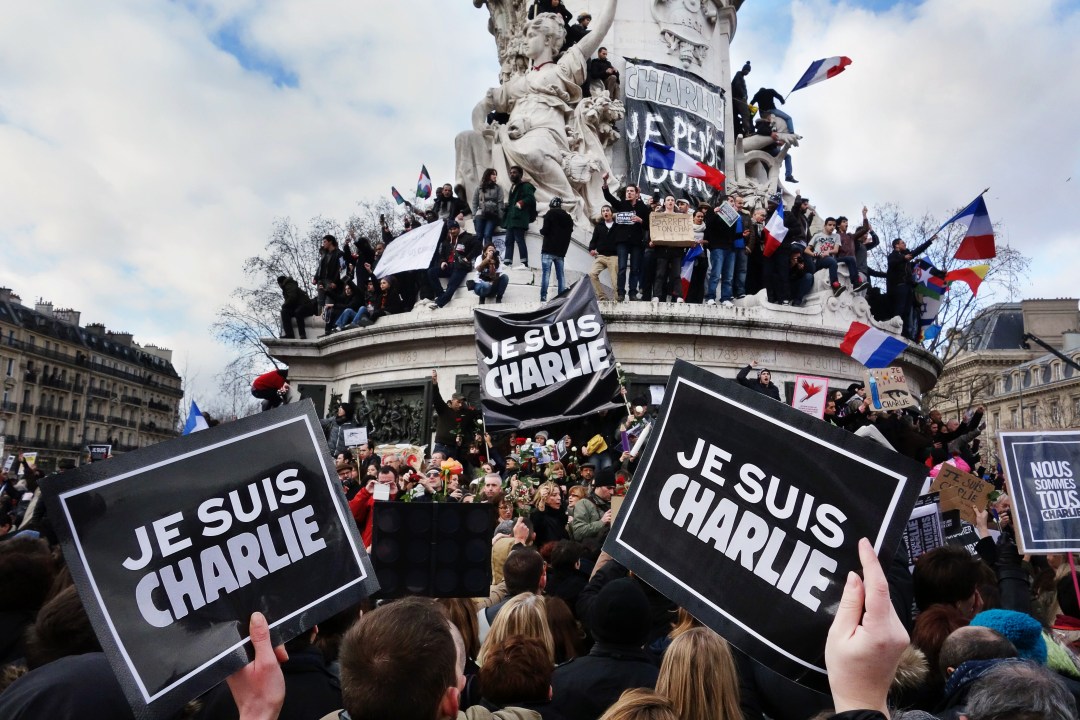
An awareness campaign in memory of the victims of Charlie Hebdo (#JeSuisCharlie) spread like wild fire across social media, accompanied with hundreds of cartoons portraying different aspects of the shootings.
Regardless of the opinions, the families of those 17 who were murdered will never forget the events that had occurred. There was no doubt these three days changed France, but the question asks – what changes will be made?
Sounds like the script of a Vincent Cassel film, right?

 Evan O'Gorman