*Contains graphic images. Viewer discretion advised.
“We are here faced by fascists – we must now confront this evil.”
– Hilary Benn
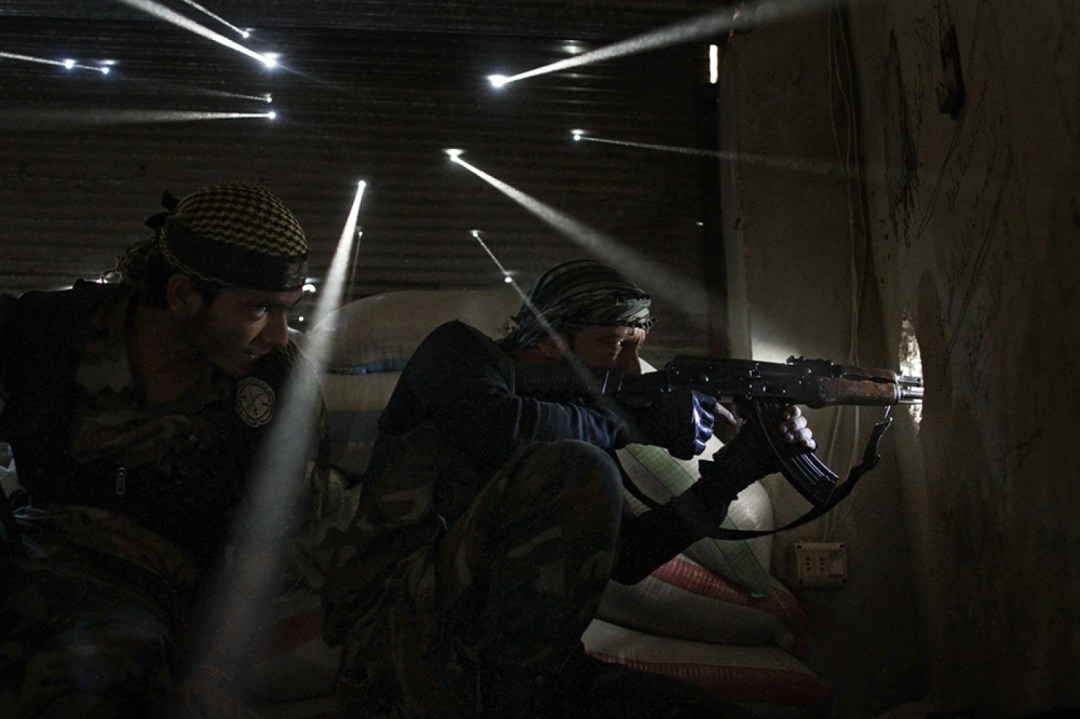
Syria has fallen, its peoples’ cries for help unanswered. Fists clench their hammers and sickles alike. Liberté mourns in the blood of her people – her wounds cut deep. Westminster has spoken. The world grows closer on an ever approaching war with Islamic State.
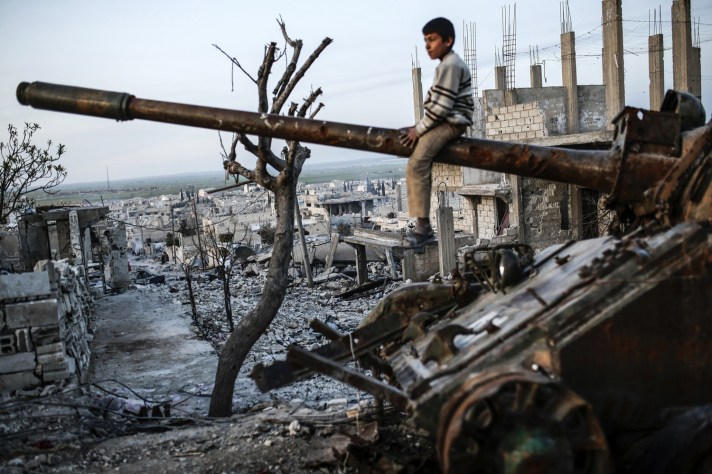
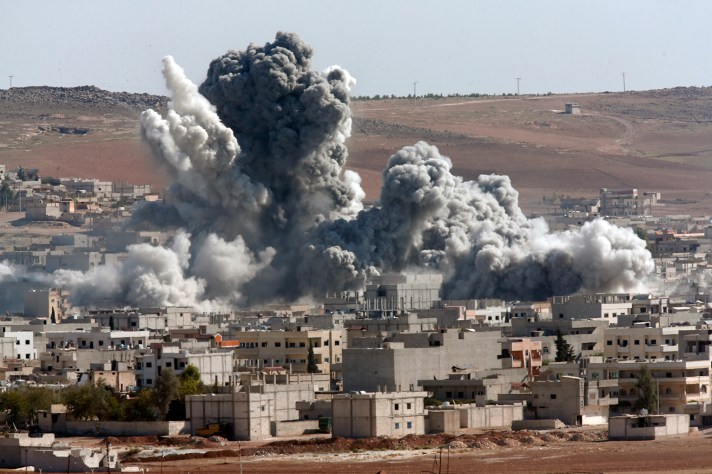
The recent operation of coalition airstrikes shows that although world leaders are keen to prevent the growing epidemic, there is mutual reluctance in being the nation that kicks the hornets’ nest. We’ve witnessed the hostility against America since their controversial occupation of the Gulf, and no politician in the right mind is willing to commit the same career suicide. But in the long run, can airstrikes alone be an effective method? If history has taught us anything, the answer looks bleak.
Take a step back, back from the world in which we live. Back to where air-strikes were first used in such high quantity: September 1940 – Nazi Germany began their aerial assault on Britain.
The bombardment was coined ‘The Blitz’ (from German Blitzkrieg) and consisted of daily bombings on cities across the UK for almost a year.
Despite almost a year of blanket bombings in the UK, and thousands of civilians killed, the morale of the British people never broke. If anything, the Blitz created and fuelled a sense of community and alliance within Britain.
This, along with the invaluable assistance from allied nations, was no doubt a key instigator in their resistance against the Nazi war machine.
But what about the present? Are there positives to take form Britain’s recent parliamentary decision? Although the aerial assault on the Islamic State has a strategical similarities to the Blitz, it is important to remember that in the age of modern warfare, intelligence is considerably comprehensive and assists in the thoroughly more accurate targeting of hostile targets.
The Luftwaffe did not have this privilege. They relied on bombing a city because someone forgot to turn their bathroom light off.
Like the Blitz, this method will impact the military and industrial infrastructure of IS. In the hours that followed the tense debate in Westminster, RAF Tycoons (bomber jets) successfully assaulted an IS controlled oil field – a key asset to the regime.
However, like the Blitz, people in Syria are living in rubble surrounded by the bodies of their fathers, their mothers, and their children.
France, America, the United Kingdom, Russia, Turkey, Jordan and many more nations have all joined in a widespread assault of the Islamic State. And despite a high level of intelligence and advanced targeting; collateral damage is an unavoidable element of war which we consistently cease to acknowledge.
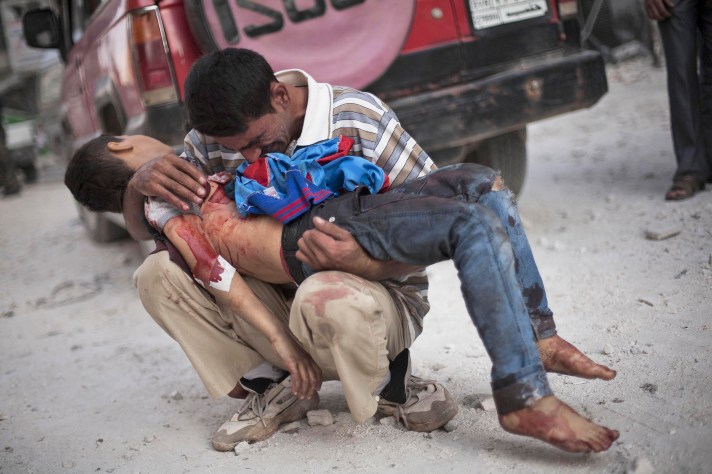
Ignorance is ignoring the fact that collateral damage and bad intelligence creates radicalisation in the minds of young Syrians, rapidly drowning them into an extremist mind-set. So although the Syrian airstrikes may well impact IS, it is doubtful that they alone will break their morale.
Following the turbulent week involving the November 13th Paris attacks, and the international manhunt that followed, French President François Hollande declared his country would pursue a ‘pitiless war’ against the Islamic State.
Pending the success/unsuccessfulness of the airstrike campaign, we may soon be faced with the notion of an invasion of Syria by western forces. A notion that back in 2013, we had hoped not to witness again in our lifetimes. But if it does happen, and we wake one morning to the news of a US/UK led invasion of Syria, will it be any different to the previous campaign against Al-Qaeda?
One of the biggest obstacles faced by western forces against Al-Qaeda was the group’s guerrilla style warfare techniques. Trying to find the group’s militants and bases proved a gruelling challenge, never mind actually fighting them. They used methods of threatening and bribery to disguise themselves and hide in civilian villages, striking at a minutes notice. Their headquarters and main operations facilities often erected in caves, deep within mountains and deserts. The west was forced to rely solely on intelligence from crude sources.
Islamic State is a very different group to Al-Qaeda, evident in their ideology, their tactics and both groups’ passionate dismissal of each other. (IS were formed in 1999, and although they were affiliated with Bin Laden’s Al-Qaeda, they separated from the group due to conflicting interpretations on the Qur’an.)
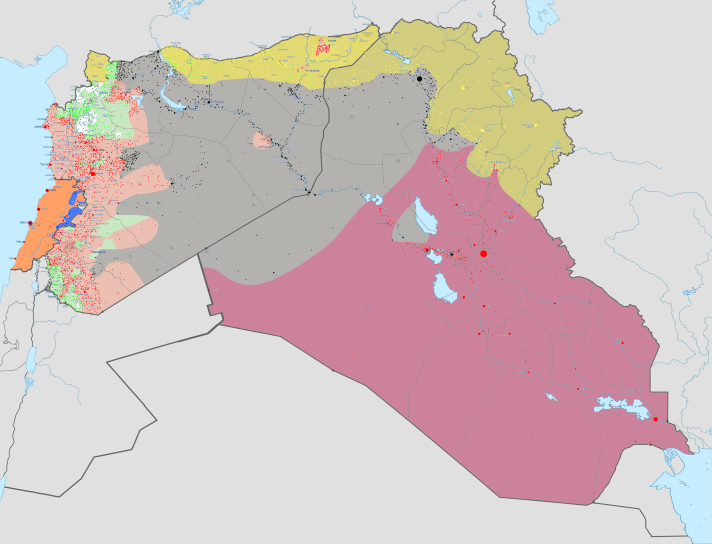 With annexed land and a self-proclaimed Caliphate, Islamic State (Black) now occupies the vast majority of Syria, along with appointing their leader Abu Bakr al-Baghdadi as Caliph.
With a zero tolerance for any conflicting ideologies, reports of a ‘police force’ and a strict chain of command; it is hard to deny that the ‘Islamic State’ is not in-fact and newly formed, highly dangerous and completely self-sufficient independent country.
Believe it or not, this can definitely be used as an advantage against IS. Why? Because they have made their whereabouts known.
In the group’s efforts at asserting their dominance and power, they may well have made things a lot more difficult for themselves in the long run.
Adding to this, although IS currently have a system of anti-air defence missiles, no form of Air Corps has of yet been recorded.
So, where does this leave us?
We stand now on the brink of Europe’s greatest crisis in over half a century. You will no doubt read a lot about what’s yet to come, just as there will no doubt be further developments in the time it has taken this to circulate its way to your screen. But one thing we can be certain of is that this epidemic is merely the beginning of the bloodiest war without frontiers the world has ever encountered.

 Evan O'Gorman