
(SPOILER-FREE)
Acting: 8/10
Writing/Plot: 10/10
Directing: 10/10
Production: 8/10
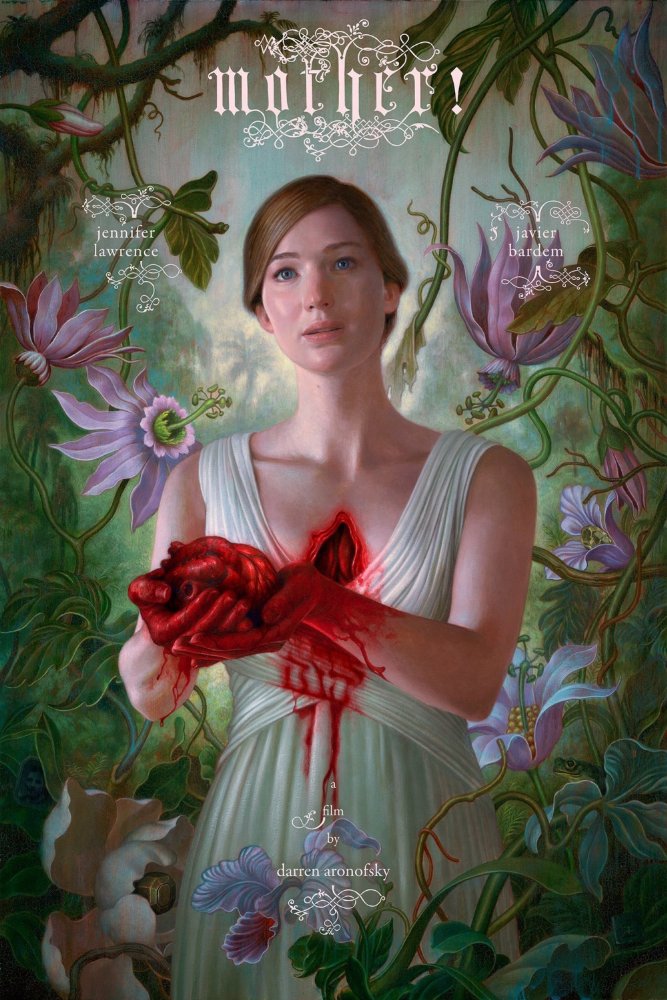
Aronofsky’s pyscho-thriller has been the subject of vast attention since its release earlier this month, but such attention has been infested with controversy.
Despite a relatively shambolic box office performance, Mother! (starring fan-favourites Jennifer Lawrence and Javier Bardem) has rapidly evolved into a cult favourite, with audiences virulently divided over opinion.
Aronofsky has managed to orchestrate a film that’s message is blatantly simplistic and harrowingly complex, balanced and disguised in a psychological thriller (not a horror, sorry Telegraph).
The film creates for an incredibly frustrating review, as to discuss too much of the plot would risk squandering the film’s message, therefor ruining the crucial combination of confusion and suspense when watching it.
But I’ll try my best.

The film depicts a couple living in solitude within their recently refurbished house. Bardem is a writer. He is working tirelessly on what is suggested to be his masterpiece, and is clearly struggling with writer’s block. Lawrence, his partner, seems fixated on house’s wellbeing, and is constantly working on refurbishments in order to create a “paradise.”
Attentive audiences will spot underlying issues between the couple from the earliest scenes, supported strongly by the consistently satisfying individual performances of both Lawrence and Bardem.
Adding fuel to the fire, things become even more unstable when an uninvited stranger arrives at the house, later accompanied by his seemingly troublesome family.
Both of our protagonists express obvious contrasting reactions to these strangers – much like the turbulent divide in audience reaction to the film.
Bardem is seen taking them in with open arms and embracing their erratic, unpredictable behaviour, adoring-fan like behaviour.
Lawrence, however, remains wary of these strangers, seeing them as a threat to her paradise and to her relationship.
Unfortunately, to comment on any more of the film’s plot would be recipe for disaster.
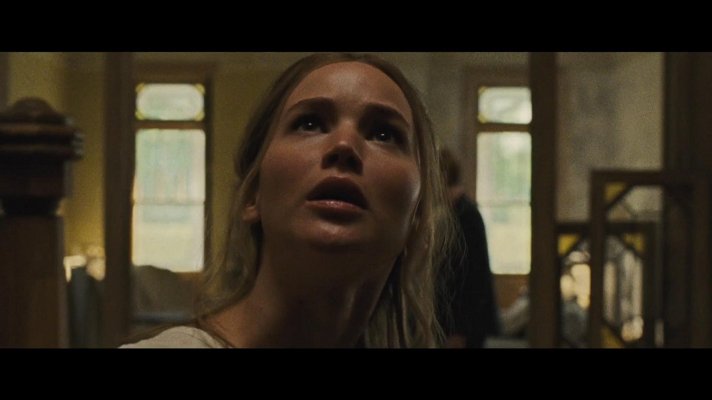
There is however much to be discussed around the subject of the polarised reaction the film has created amongst its audience.
Anyone I have spoken to – or read of – has expressed one of three reactions:
- They have deemed it as a brilliant piece of cinema, and have thoroughly enjoyed it.
- They have utterly detested it (reports of audiences walking out of the theatre) and have been quick to shun it as a “flop.”
- They have acknowledged the importance of the film to the culture of film making, art and storytelling. However, they have admitted it was not an experience they have enjoyed.
Two of three of those reactions are correct, both in their own way.
Mother! is fundamentally a brilliant piece of art. Before you start overheating and counter arguing with generic quotes you read on the back of an intercity bus seat about how art is personal or interpretative, think about what a film is, or more so, what it is supposed to achieve.
According to EICAR, “Films are cultural artefacts created by specific cultures, which reflect those cultures, and, in turn, affect them. Film is considered to be an important art form, a source of popular entertainment and a powerful method for educating — or indoctrinating — citizens.”
Break down Mother!’s plot, and it covers all of the aforementioned points by EICAR.
A film is supposed to tell a story. It is supposed to do this in an entertaining and engaging way. It is also, on a more philosophical artistic approach, intended to promote an alternative, transparent message masked by the face of the film which the writer and/or director wants to tell their audience.
Mother abides by every one of these rules, complemented by stellar performances by both Bardem and Lawrence and mesmerising production values.
Mother! is potentially one of the best made films of the 21st century.
Whether or not you enjoy it is down to individual taste. But should you understand – or attempt to comprehend – anything of storytelling-art, you will appreciate the awe in which it inspires.

This difference between what is taste and what is fact are what I believe has created such divide amongst the film’s viewers. As with a lot of things, particularly art, opinion and expression make up the basis to which a consumer will form their judgement. But we live in a society where the word ‘opinion’ has become a ‘get-out-of-jail-free-card’, being carelessly flung about to mask the user’s ignorance on a subject matter.
Storytelling and its relationship with art is an honest form of expression. But there are fundamental rules in which each artistic subcategory must follow. If every form of art was so feeble that its quality was based on an individual’s opinion, the world would have descended into an insane frenzy of florescent shit smeared aimlessly across tall statues of St. Nigel Farage’s right testicle many moons ago.
I won’t go into the psychology of art, because I simply don’t know enough about the subject. But if you consider the basics (entertainment, storytelling and education), good pieces of cinema will follow these. Always.
I regularly watch channel 4’s ‘reality’ TV series Made in Chelsea. I generally uphold a very high standard of media I consume, particularly when it comes to committing to a TV series, but can say with all honesty and pride that it is absolute garbage. But yet I watch it, and I like it.
Why is it garbage? Because apart from its admittedly highly entertaining properties, it possesses no structured formula for telling a story and has – I sincerely hope – no underlying message of educational value.
On the other hand, popular fictional political show House of Cards falls directly into the category of media that I would usually drool over. It is highly entertaining, its writing allows for complex and diverse storytelling, and it battles with the philosophy of power, greed and consequence.
I watched the first season. I didn’t like it.
The politically obsessed, high standard media junkie didn’t like House of Cards.
I don’t quite know why, but I didn’t.
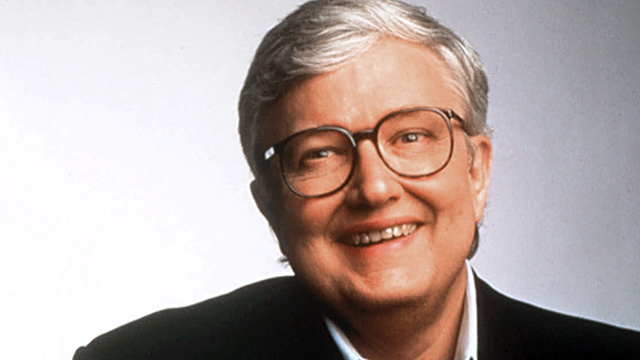
The late Roger Ebert, a renowned journalist, film critic and all around Messiah of film wrote an account of his teaching for the Guardian in 2003.
Ebert attended the Conference for World Affairs in Boulder every spring for almost 40 years. Each time he would conduct a week long film exploration course with the students present.
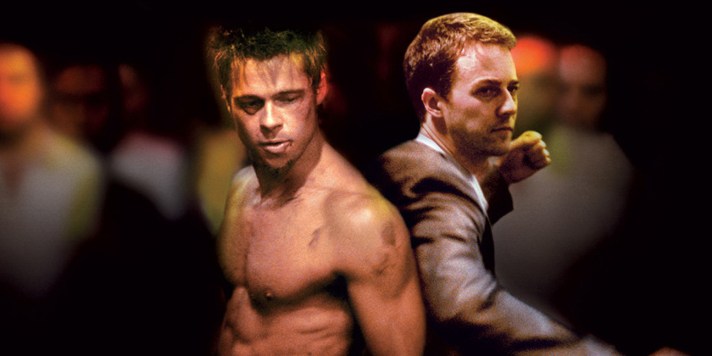
He recalls one year when he suggested reviewing Vertigo (Ebert was renowned for his obsession of Hitchcock) with the students. They however persisted that Ebert let them review cult classic Fight Club instead. Eventually he settled to review both. But the point is this:
Elbert admitted “Fight Club was not a film I approved of, although I recognised its skill and knew from countless emails how strong an impression it made on its admirers.”
Elbert was an undisputed genius when it came to the study of films, and understood the difference between disapproving of something and respecting something.
Brussel sprouts and Mother! are surprisingly similar.
Brussel sprouts are good for you. They are a vegetable. They are packed with nutrients. So why do so many people hate them? Because they dislike how it tastes. It doesn’t mean they’re not a good food; they just don’t like the taste.
So why should films like Mother! differ? We know there are clear outlined boxes a film must tick, and should it do so, who are you to say it’s a bad film simply because you don’t want it with your Christmas dinner?
What’s the point of all this? Just because one enjoys a piece of art, does not necessarily mean said art is good art. Similarly, just because one does not enjoy a piece of art, does not mean said art is bad.
An opinion depends on taste. But you must appreciate the objective quality of what it is you like or dislike, regardless of your opinion.
Making Black Swan look like a CBeebies ballet cartoon, Mother! is dark, heavy, and at times difficult to watch. I would recommend everyone sees this film, despite anticipating that many of you won’t like it. I am certain that it will be remembered as a genre-making classic which is sure to trigger emotion amongst viewers and ignite a new era of thought provoking cinema for decades to come.
Bar American History X and There Will be Blood, giving films top-marks is something I rarely do. I wasn’t sure whether this deserved it, but looking back, I genuinely cannot fault it.


 Evan O'Gorman
This is such a thoughtful and well written review — I really enjoyed reading it.
LikeLiked by 1 person
Thank you so much!
LikeLike