*If this is your first time reading the ‘Where the Happy Folk Live’ series, it is recommended you read Part 1 first.
“What we seek is a new and a different way of life.” – Selassie
This is a world of utter contrast to my own and nothing makes any sense to me. It is without shadow of doubt that the people of this strange world would be equally as bewildered in a place like Athlone, but forcing one to go to Athlone is a fate I would seldom wish upon another human being. Apart from the oddities outlined in part 1 and 2, there are some that will provoke great confusion in a naive westerner here, such as the recording of time. On the flight over I briefly scanned through the on-board magazine and noticed the issue date was marked as 2011. I couldn’t tell if this was either a misprint or a severe lack of attention to detail from Ethiopian Airlines, though either would have been of equal concern. What I failed to anticipate was that Ethiopia operates on a different calendar to the Gregorian one that we are used to. Although they have the same number of days in a year and include leap years every four, there are 13 months in the Ethiopian calendar, with the 13th month consisting of only 5 days. The calendar derives from the Egyptian calendar and differs from the Gregorian based on a difference in calculation of the Holy Annunciation. Because of this difference in historical belief, the current year in Ethiopia is 2011 and they celebrate New Year’s Day on September 11th.
lll
Adding to this peculiarity is the way one tells the time. It terrifies me to the extent that Dickinson herself would be sectioned at the very thought. Ethiopia has two clocks: there is the universal 24/12 hour clock, but there is another system that is based on the number of hours post sunrise and sundown respectively. This abominable system caused a moment of savage confusion later in the week when I was sitting in the lobby of the Florida International in Gonder on my last night in Ethiopia, after a harsh week in Debark. I was drinking a Habesha and reading a book when one of the English-speaking managers offered to arrange a car to the airport for the following morning. I told him we needed to leave at about noon and after some shuffling of stacks of papers and ledgers under his arm he turned and told me that another group were going to the airport around the same time as us. “It would be easier if you all went together, so does five suit?”
lll
I stared blankly at him for a second.
lll
“Five..?” I asked hesitantly. He seemed confused as to why I was questioning this, but I doubt it matched the confusion that gripped me. I looked down at my beer and recalled how many I had consumed that evening. Only three, so there was no pinning this on them.
“I don’t understand,” I replied. “Five?” If he was referring to 5am, we would be almost seven hours too early for our flight. If he meant 5pm, our plane would have arrived in Addis, returned to Gonder and served the afternoon flight, which we would also miss because it was that late. There was a brief but seemingly eternal moment where ‘Andy’ and I stared at one another sharing a politely confused smile. It felt like a short lifetime until I recalled watching Ethiopian news the day before and seeing a clock that read 9:06 at about 3pm. Zinabu explained the clock situation and I was able to calculate that Andy was referring to 11am, merely an hour before our desired time. Andy and I laughed about the confusion and although understanding quite clearly what had happened, I went to bed feeling puzzled and betrayed.
Day 3.
We left for Debark the next morning at about 7am. I rode shotgun on the hour and a half journey in order to capture as much as possible with the camera. Clusters of people sat and stood idly on the roadside waiting for lifts, all sticking out a hand to hail whoever might pass by. Tuk tuks forced their way across the road, some packed with six or seven people at a time. Young, withered children clothed in torn rags and dirt embedded deep into the creases of their skin carried bounds of wheat and crops almost five times the size of their own body and likely weighing the same for distances I could not imagine. The most chilling sight was that of a woman standing roadside with her small child tucked into a wrapped shawl around her back. She stared gauntly at us as we passed her. She did not try to hail us nor make any gesture. She just watched, and so did we.
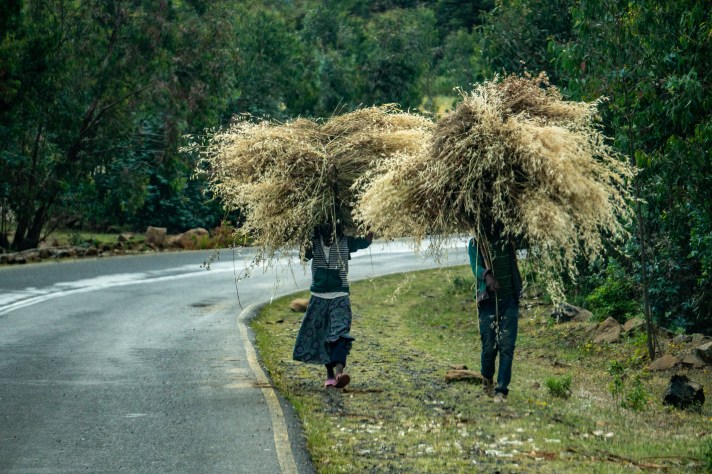
The road cuts through valleys and covers plenty of cliffsides, so you could not help but find yourself gazing out into the distance on several occasions for what must have been hundreds of miles into an uninhabited abyss of colourful growth and treacherous mountains. Again, it wasn’t the sandy desert one might expect to see in Africa, but rather one of colourful grassland with clusters of eucalyptus forests and standalone Marula trees, the iconic African tree that grows in a thick, single trunk that bends slightly toward the top, with the branches and leaves forming an almost flat head which gives shade to all who seek it.
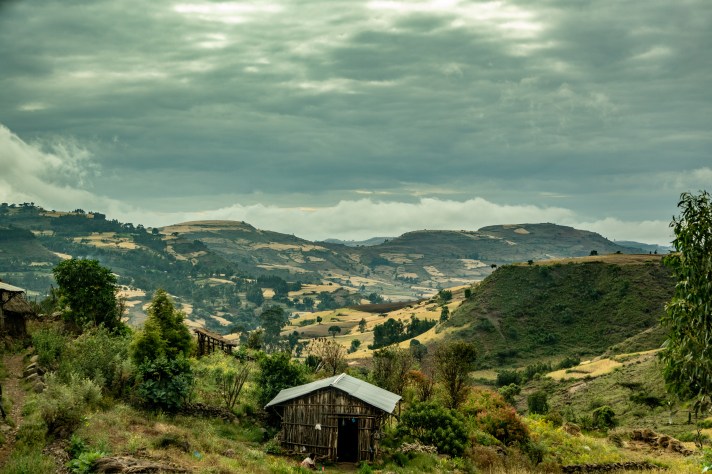
About half an hour before Debark the change in altitude slapped me across the face. We had been hovering just above 2000 metres in Gonder, which was a sizeable shock to the system already but only really noticeable when doing something strenuous. Now we were flirting with the 3000 metre mark, making breathing and talking quite uncomfortable. The full impact of this altitude hit us like a steam train when we arrived at the hotel in Debark and had to walk six flights of stairs to get to our rooms. This was challenging to the point of embarrassment as the staff skipped past us with our collection of 30kg suitcases.
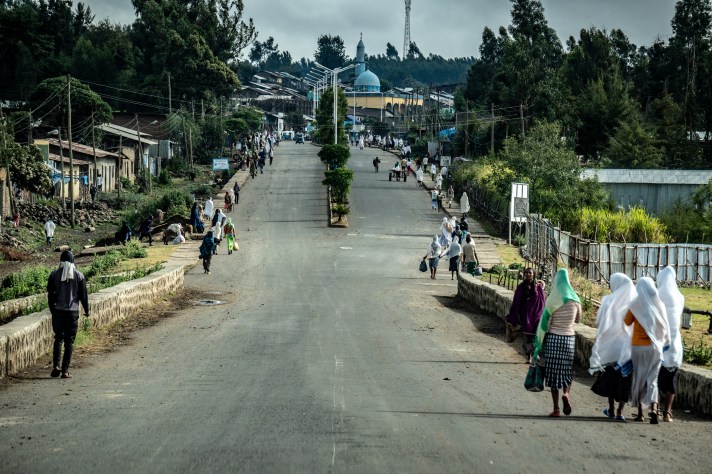
The Sona hotel is easy to find but frustratingly difficult to get to. It is a place of mystery and wonder and although designed for westerners travelling to the Simien Mountains, it is not like anything you will ever see north of the Mediterranean. It is one of the tallest buildings in the town and you can see it from most of Debark so long as your view is not obscured by a passing lorry or a stray umbrella caught in the wind. The road wraps up to the left of the main street, which is lined with people going about their business and random animals who seem to do the same. Once you turn onto this road the smooth tarmac becomes a distant memory and you are forced to recon the ground as you walk hesitantly in order to avoid deep craters and large chunks of pointed rocks. It was a passage that lacked obvious direction or structure and was often littered with bits of plastic and small animal bones. The hotel isn’t far along this road, but getting to it by vehicle is not easy.
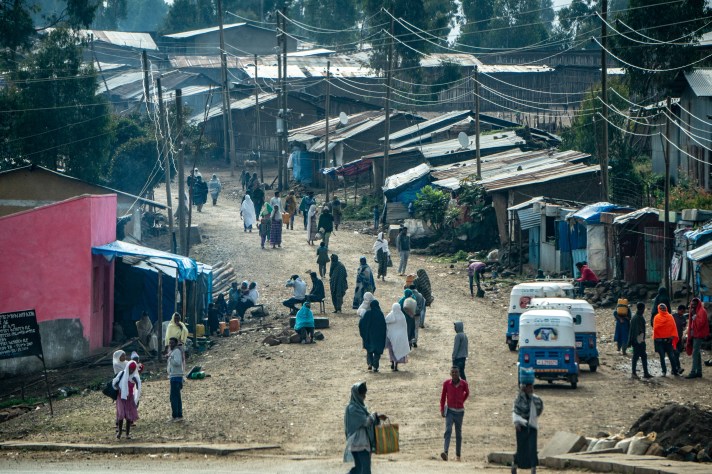
It is a tall but narrow building likely inspired by the same mind behind the infamous 1960s Ballymun skyline. It is white and yellow and stands about five stories tall, giving guests a breathtaking view across almost all of Debark. The Sona Hotel is run by a man called Gurma, who we are confident is also the owner. He is a tall, stocky man with a deep and booming yet delicate and wholesome voice. His skin was far darker than most of the Ethiopians I had seen so far and he wore only two outfits: a grey, baggy tracksuit and sandals (which he only really wore in the early hours of the morning) or a fine navy blazer with a shirt and jeans. His English was good – given the standard we had so far encountered – and he always seemed very stoic, to the point he would almost glide through the hotel. During our time at the Sona I could not help but draw constant comparisons to Torquay’s Fawlty Towers: here was a gigantic and ever present hotel manager who seemed to have a very strange relationship with his staff who consisted almost entirely of Manuels, from whom there was no shortage of surprises. Nobody had a word of English and if you ordered food it was impossible to tell whether or not you would ever get it, and if you asked for some knives and forks for five people you could be given a handful of soup spoons and a lonely knife.
Because we had arrived a day prior to that expected we all had to share a room, apart from Zinabu who managed to get a room to himself, but he didn’t have a light nor his own toilet and there was a gaping hole in the window. The rooms were very clean, however the bathroom produced a smell I never want to experience again.
Once settled, we met with the Ethiopian parents (Mesefent & Guadada) of Elaine and Niall’s son in the lobby. Although it is neither my place nor intention to share the details of this encounter, even for the emotionally artificial person that I am it was a deeply moving moment.
Elaine and Niall had been tasked with purchasing a couple of Oxs for the family with money donated to them from their local community in Ireland. We left the hotel at around noon with Mesafnt and Godada and headed to the far side of town where the livestock market took place every Wednesday and Saturday.
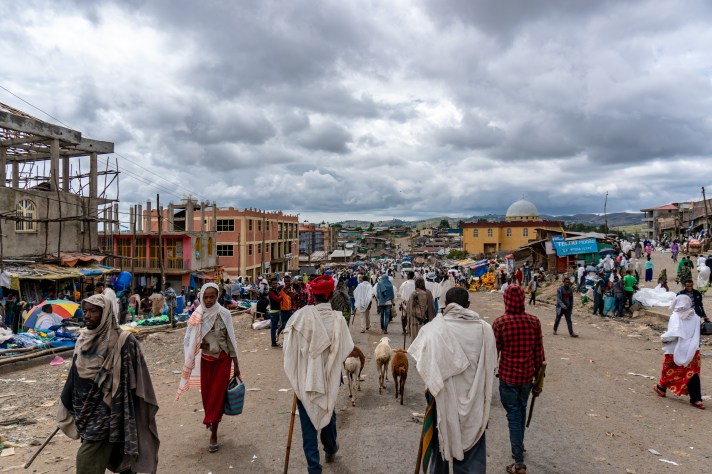
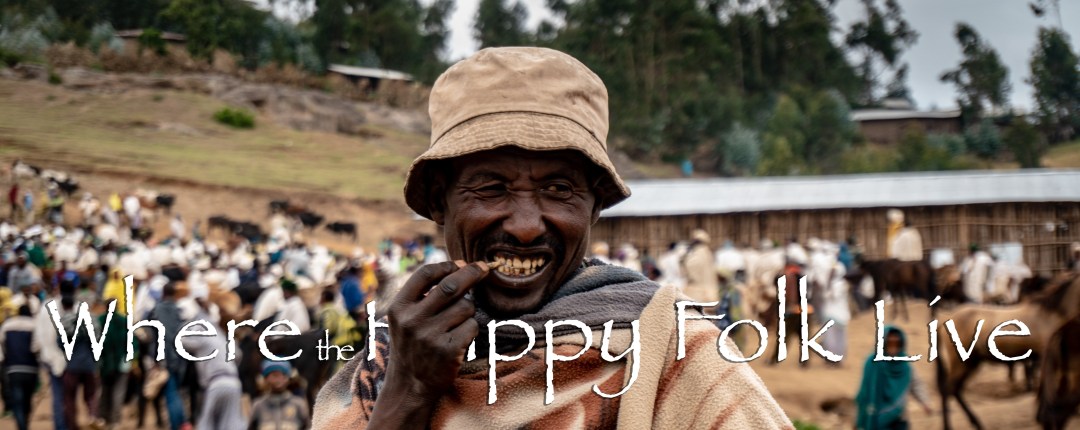
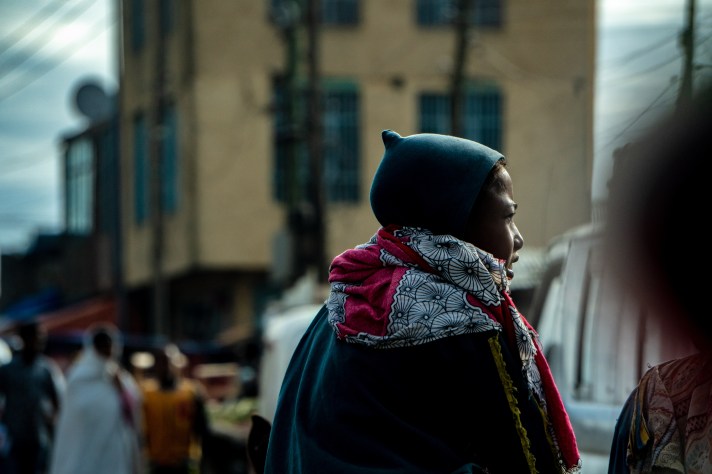
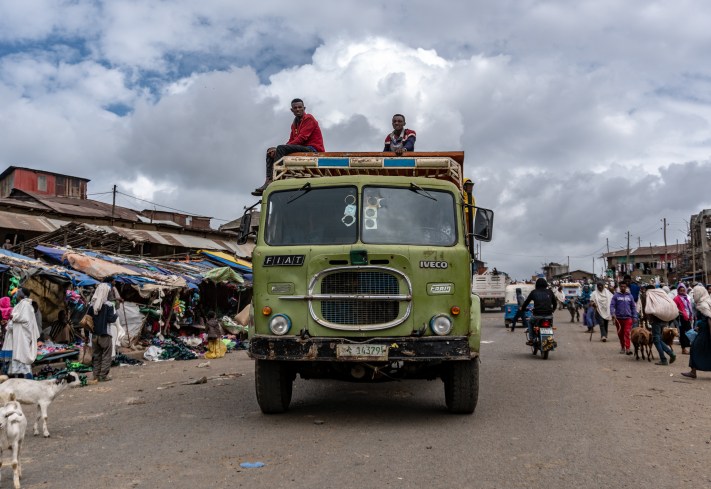
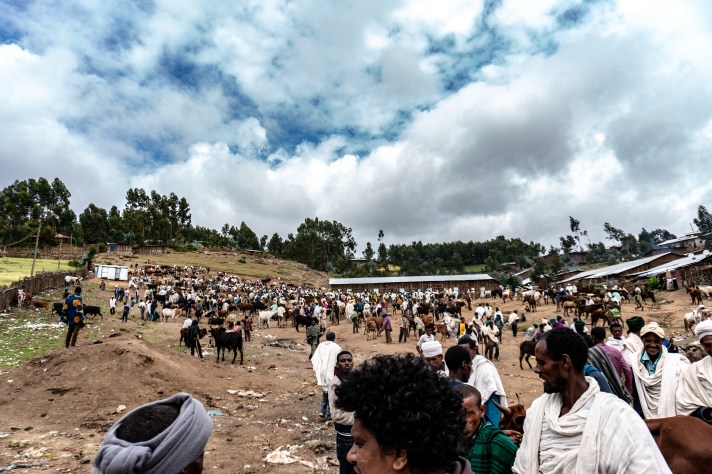
On any normal day Debark is in a constant state of flux, but on market days it becomes the busiest town on Earth. It is the epitome of organised chaos and the people here do not seem phased by the madness of it all. Folk of all ages scrambling and wandering around the street in search of their next customer whilst battling the motorcade of tuk-tuks, cars, lorries and motorbikes. A dynamic mix of people populate this arena, from shoeless children whose ribs will penetrate your consciousness to stylish teenagers rocking fades and four-stripe Adidas high tops, weathered women shuffling through the alleys with any number of children beneath their clothes and old men dressed in white dresses carrying large sticks who seemed in a constant state of meditation. You take in a lot in whilst walking through Debark. On the face of it, the town represents everything a third world country stands for. Most of the buildings were single story and seemed like extensions of the road. They were built with a collection of different materials and the doors were often large rusted chunks of sheet metal either propped up against the doorways or tied to a pole with some frayed rope. Small children emerge from these humble homes, followed by their mother and siblings. From the slight gap behind them you can see that their floors are mud or dirt and there is little to no light at all. Throughout my brief exposure to Gonder I was taken back by my surroundings and its people and was baffled as to how people could live in some of the conditions I witnessed. But from Debark, Gonder looked like a thriving metropolitan city. We were in the Killala of East Africa, and we were here to stay.
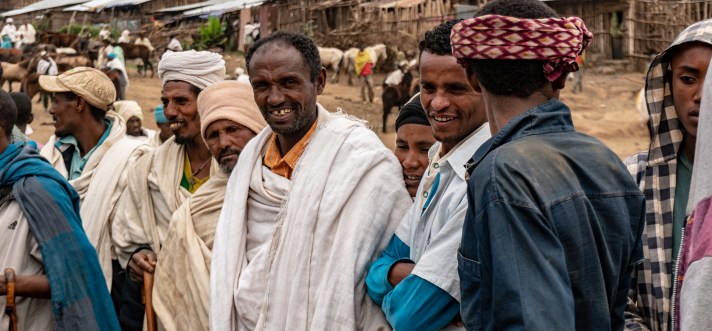
The moment we stepped outside of the hotel, a cluster of children were on hand to start following us from a very intimate distance. This continued as we made our way around Debark, with more and more joining the entourage. What began as an innocent accumulation of seemingly bewildered children was soon followed quickly by older children and eventually adults until we had a posse of about 20-30 people escorting us across the town to the market. It was a most surreal experience. They looked a lot different to those I had seen in Gonder, with many opting for a far more traditional dress sense and almost everyone – even the girls – had tightly cut hair. To add to the discomfort of it all, nobody could speak any English so you were instead met with constant staring and faces of wild intrigue. Those who mustered up the confidence to talk to you would say things like “Hello, how are you?” and “Hello, what is your name?” However, it seemed as if they had learned these sentences not as a series of individual words, but as one long word. At least that is how it sounded, as they would pronounce it like “hellohowareyou” and “hellowhatisyourname.”
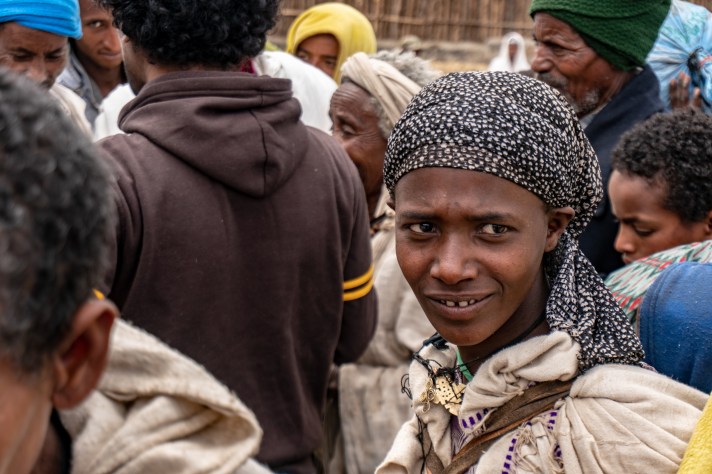
The eight of us – Elaine, Niall, the two boys, Zinabu, Mesafnt, Godada and I – made our way across town to the market, escorted by our new friends. It is just on the edge of town on the road to the Simien Mountains, and you have to hop over a strange trench on the side of the road to get to it. I had thought the trench was intended to stop the animals from fleeing too far, but the constant struggle of farmers trying to contain their flocks that leaped ungraciously across the trench squandered that theory pretty early on. The market was in a large expanse of dirt which covered a wide area of land on the edge of a hill that was filled with thousands of hustlers. It was recommended that the Irish folk did not accompany Mesafnt, Godada and Zinabu as they reviewed potential Oxs, as their traders would likely charge more if they knew foreigners were involved. We left them to it and the five of us hung around the edge of the market – just beside the trench – until the others found what they were looking for.
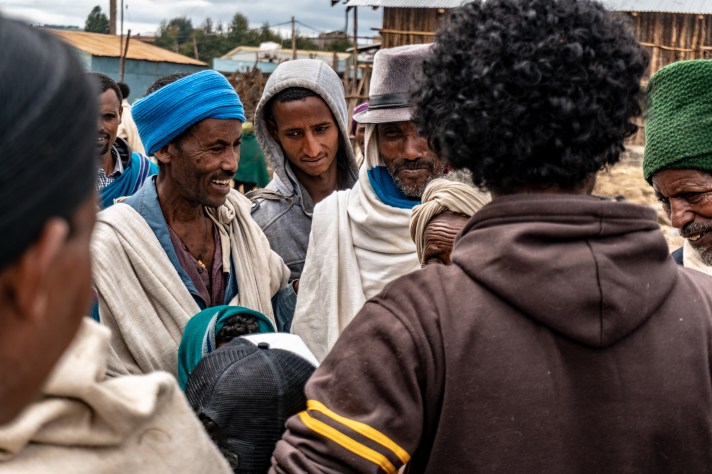
This allowed the crowds who had been following us around the town time to stop and get a good look. It also allowed even people from the market and the street to gather in the amusement of our presence, with a crowd of about 100 eventually forming around us on the middle of the main road. It was madness, and after a while we all began feeling pretty overwhelmed. As the impending sense of dread continued to mount, Elaine, the boys and I walked back to the hotel with an escort of about 30-40 people. Despite our party dropping to four, the crowds continued to grow in as we made our way back. It seemed as though everyone in the town knew exactly who we were and had an obsession with seeing us, especially the children. The idea that one of their own had grown up in a foreign land was fascinating to them, as was the opportunity to see a white child, something that was very possibly a first for Debark. But the excitement seemed to get the better of the crowds who grew increasingly curious to the point of wicked dismay. It had gone from staring and following to touching and hugging. They did not mean any offense of course, but we knew it was time to hide out in the hotel for a while. Despite our best efforts to humour the crowds, our manners took a back seat and we rushed back to the hotel where we stayed for the remainder of the afternoon. The few hours in Debark had taken their toll on us all, even Zinabu who returned with Niall shortly after. We stayed in the hotel for the rest of the day and took turns napping.
This was the outback. The peripheral. It was Africa’s answer to the Wild West. No real rules or standards, but plenty of respect and habit. Dazed, dehydrated and confused, I woke up a couple of hours later and spent most of the evening watching Debark from our third story window. As I gazed down into the streets in awe, I spotted a woman sitting on the roof a building which looked to have once started constructing a second story but never quite finished. She sat on a pink, plastic chair and in front of her lay a number of dead, gaunt chickens. With a metal bucket of dirty water she proceeded to pluck each chicken and hang it up to dry, likely destined for tomorrow morning’s breakfast. I also saw a young girl – no more than five – herding a flock of sheep past the front door of the hotel. One of the sheep broke away and made a B-line to the reception. She doesn’t notice at first, but the upset it sparked amongst the staff stole her attention and she hurried over to intervene.
As the evening winds in, the sun sets behind the cusp of the distant mountains allowing only a handful of light streams to pierce through the corners of the town. At night, she slumps into a state of total darkness. It stands still in the shadows like nothing I have ever seen before. There are virtually no notable sources of light, bar a few audacious tuk tuk drivers working late, or the fire from an evening meal seeing itself out. With the darkness also comes a striking silence that echoes the streets. It is a sound you cannot hear, but is so loud that you often cannot ignore.
I could not conceive how this world worked and I doubted I ever would. The question that lingered in my mind by now was that of existentialism. We live on the same planet, a mere speck in the universe, but as far as I could make out we shared virtually nothing with each other’s worlds. Here were a people I did not understand and they likely did not understand me. As a westerner, my circumstances were likely superior, but I could not help but feel a looming sense of inferiority to these people. I was staying in a hotel with clean bed sheets and bottled water, while many of those I met today may never have seen running water in their lives. It would be lazy and cliché for me to ponder my circumstances and be grateful, but for what would I be grateful? The materialistic world in which I have left for a place of raw happiness was a lie to me, so too seemed the reasons for which I lived. I had no say in the life I had been granted, which is likely the only common ground I could ever share with the people here. There was no feeling of guilt involved, but one of unlikely envy. One from the west could not imagine a life lived here. It was poverty in its purest form. Not like the poverty they throw around in political debates in Ireland, but one of genuine destitution. But they were happy. They were happier than anyone I have ever met. How could this be? Their lifestyles will spark little in terms of jealousy, but their honesty, their grit and their raw happiness was something that the unsuspecting consciousness may grow envious of. Perhaps this is the altitude talking, or perhaps I was seeing a truer form of life.
lll
If you ever find yourself in the depths of Amhara and through a series of unlikely circumstances happen upon Debark, I would advise you to wake up at around 5am and find a nice perch overlooking the streets. During these early hours of the morning you will surely catch the dawn haze that sits delicately over the town. It rests motionless for an hour or so before seeping into the ground and making way for the ocean of fumes from the many billions of tuk-tuks, lorries and jeeps that dictate the smell, sound and order of Debark. Once the haze has cleared, the true essence of Debark’s hustle and bustle breaks free.
Part 3 of ‘Where the Happy Folk Live’ will be available next Wednesday, January 9th.
Full gallery of images from the aforementioned day below.


