*If this is your first time reading the ‘Where the Happy Folk Live’ series, it is recommended you read Part 1 first.
“This – is now my way – where is yours”? Thus did I answer those who asked me “the way”. For the way – it does not exist!” -Nietzsche
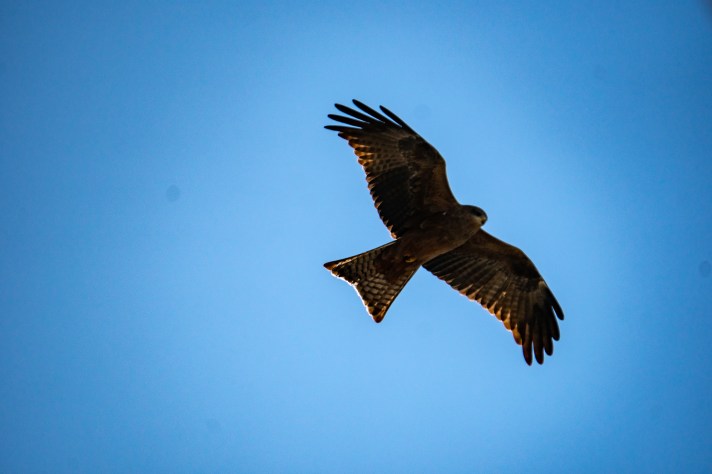
The Lammergeier swoops and dives through streets and alleys of Debark, forever stalking his next meal. His wings span three metres wide and his feathers paint gaping shadows on the ground. He is not like the vision of the sole eagle that hovers patiently in solitude; the Lammergeier patrol in numbers and on any clear day you could observe three or four elegant beasts patiently plotting. On one gentler morning I watched one pursue a crow around the town for about 7 minutes, before calling its bluff on a sharp turn and clutching the desperate raven with his piercing talons. He tore the creature clean out of the sky like a a ground-to-air missile and with a cloud of black feathers the crow was gone. The Lammergeier is the epitome of free will. He sails independently of any society or regime and acts only on his own instinct and cunning. He has the freedom of the skies and controls the ground he watches over. He chooses his prey and has little to nothing to fear. He has the strength and stamina that can take him far and wide, miles and miles into the beautiful Abyss of Africa and beyond. But the Lammergeier stays in Debark his whole life, like that of its parents and its young, who will never see anything but these narrow streets. “Why is this?” Asks the Lammergeier. Well, my poor fellow, it is simple. The Lammergeier does not know of the world beyond Debark. He wakes up, finds his food, cares for his young and goes to sleep. He is a creature of mighty ability whose free will allows him no opportunity to leave the small African town. He knows not of his potential; but only of his survival. So in what tragic universe does the creature who’s free will lacks the freedom and willpower to expand his own reality? But what reality is missing, if his own free will does not allow it to exist? The Lammergeier’s free will demands he never ventures beyond the confines of what he knows. He is a prisoner to his own instinct and cunning. The Lammergeier does not abide to any government nor religion, nor does he fear a predator greater than himself. As far as the Lammergeier is concerned, he is King.
Day 4.
After waking up from our first night in Debark I was greeted at breakfast with the good news that there was now a room available for me. I had come down for breakfast about 6am, which was the earliest I had been up in a long time. It is easy to get a long night’s sleep here and be up at 5am, because once the sun sets and darkness grips Debark there is very little to do apart from twelve straight games of chase-the-ace and the same Champions League highlight reel you’ve seen 25 times. Debark is also extremely prone to power cuts, with blackouts lasting between twenty minutes and eight hours. You could be sitting in the bar eating your dinner when a blackout occurs and there is absolutely no light whatsoever. It’s quite fascinating to see this, because the locals who would meet up and drink in the hotel payed no attention to this and continued their conversations as normal. In contrast, we – as well as the other westerners staying in the hotel – would be rendered almost completely helpless, like a group of hens whose owner forgot to lock the coop.
The majority of people staying in the Sona hotel were white westerners, mostly from central Europe, who were on one of those ludicrously expensive package holidays you see on Facebook for an “authentic African experience” and visiting the nearby Simien Mountains. This landmark was what kept Debark’s economy ticking over, and the visitors would usually only spend a night or two in the town before departing to their next exotic location. Of course, they seldom left the hotel unless they were travelling in a large bus with tinted windows, allowing them to briefly observe the locality from the safety of their anonymity. Throughout our six night stay at the Sona we encountered several groups and individuals from all over Europe and America. One particular group – who we established to be Belgian – arrived on the same day as us and stayed for three days. They were a sour, miserable bunch who drew vulgar dissent from everyone around them. They were foully obnoxious and rude and lingered around the different parts of the hotel like the smell of stale puke, impossible to shake to the point of reluctant acceptance.
Sona breakfasts were a shock to the system at first. It was always a buffet that started at 6am which included a variety of rice, meats, scrambled eggs, potatoes and dried bread. After a few days I found myself totally adjusted to the diet and immediately noticed the superior effects of it compared to my usual cereal-exclusive breakfasts at home.
My new bedroom had three beds (for reasons I did not stop to ask) and was on the forth floor. The bathroom had the same rigamortis-like smell as the room I had shared with Elaine and Niall, but I had a balcony which you could step onto (precariously) and look over the whole of Debark. I was a floor higher than I was before and the view was astonishing. It was the top floor of the tallest building in town meaning I was standing higher than anybody for miles around. There was a metaphor festering here, but I was too distracted by the goings on around me to pay it the attention it required.
Elaine, Niall, Zin and the two boys made their way down to breakfast shortly after me and we discussed the plan for the day ahead. A cousin of Godada was to meet us shortly and arrange tuk-tuks that would bring us to the village of Mesafnt, which was about 30 minutes from Debark. The cousin was in his early thirties and wore a stern look of severity. He had one of those faces that if you did not know him, you would not want to piss him off. He was, however, like an armadillo; from the outside he was a hardy buck, but it didn’t take long to discover he was an extremely gentle man and had a heart of gold. His name was ‘Zinacho’, so to avoid the confusion of having two Zins in the party I referred to him as ‘Nacho.’ He had very little English and could understand more than he could speak. He was calm and collected, but not to be messed with.
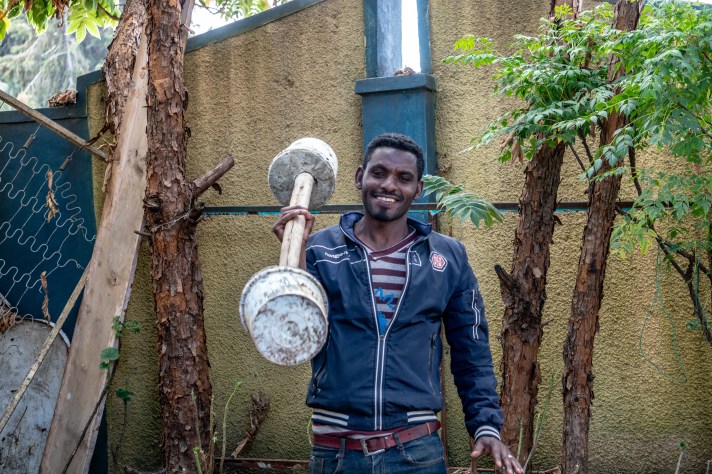
The village to which we were headed that morning was Quha Zab-Zaba, where Mesafnt had invited us to his home for a traditional meal and coffee ceremony, as a way of celebrating his son and his son’s family’s visit. His former wife, Godada, and her new husband would also be attending, despite living many miles in the opposite direction.
We finished up our breakfast and got changed as we had been advised to bring a set of clothing exclusively for visiting the village. Where we were going, animals lived and slept in very close proximity to the people there, so it would be open season for opportunistic insects. Nacho and Zin were waiting for us with two tuk-tuks and their drivers when we got outside the hotel. Like the drivers in Gonder, they were both young men – about my age – who were clearly very excited to be bringing us to the village, although they had little to know English at all. Myself, Zin and Nacho sat relatively comfortably in one, as Zin rode shotgun with the driver with whom he chatted for the entirety of the journey. I’m not sure if this was a trait shared throughout Ethiopia, but Zin seemed to take pleasure in light hearted conversation with pretty much anyone he met. I wish I could have done the same, but many hours spent learning Amharic would be required.
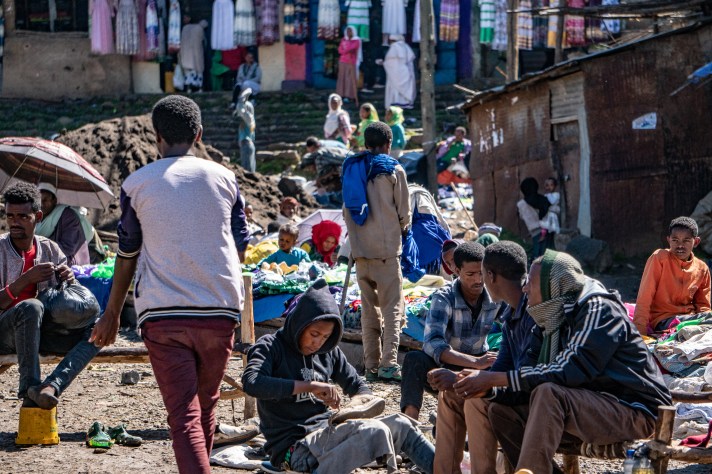
Elaine, Niall and the two boys crammed into the other tuk-tuk, but they all sat in the back which from what I could see made for a very uncomfortable ride. Our motorcade made way out of the hotel’s garden and onto the road on which we walked to the market the day before. Thankfully we were relatively concealed inside the tuk-tuk, so by the time someone did notice us we were out of sight. Debark was not as congested as the day before, but the small town was still far busier than Dublin City on Christmas eve. There were less farm animals wandering the streets which meant the driver could navigate without the fear of hitting one, although the j-walkers often needed encouragement in the form of some strongly spoken Amharic words. The gravel road went up hill and out of town in the direction of the Simien Mountains and once you reached a certain point you could not help but take in the spectacular view that overlooked Debark.
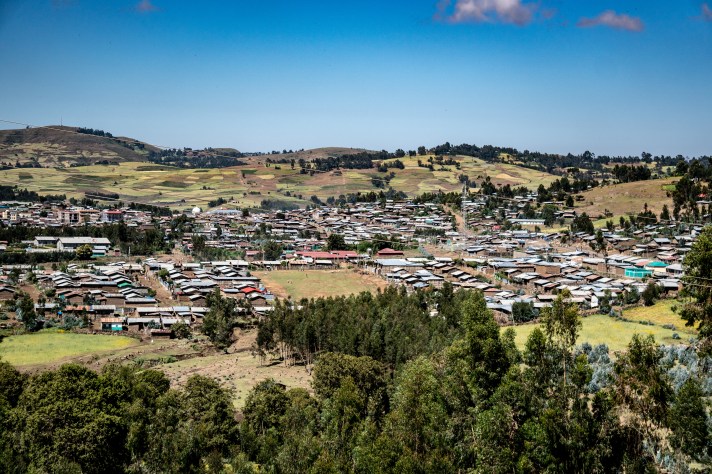
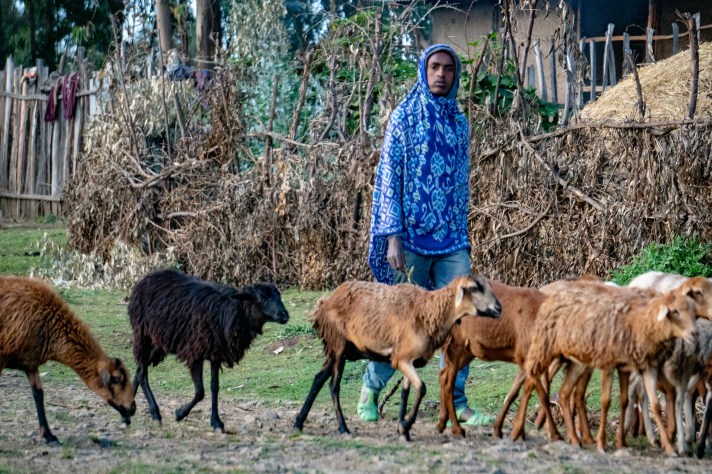
After about 10 minutes of the tuk-tuk struggling to get up the hill, we turned off into what looked like the remains of a six-yard box on a football pitch in east Carlow. The grass patch on the side of the road was worn away completely in the place of moist dirt and tracks from wheels and hoofs alike. You would have to be familiar with the area to know the passageway was there, as the trees around it almost completely camouflaged the entrance. We were now off-road in East Africa in three-wheeled tuk-tuks that had literally no suspension built into their design and wheels as narrow as my road bike. To say the ride was rough would be an understatement, as the drivers avoided massive sinkholes in the ground, random craters and wandering children who would come rushing out from the trees to see what was going on. There weren’t many people on the road, but enough to know you were going somewhere. We were also the only form of motor-vehicle that we saw, as most people would either be walking or occasionally travel on horseback. This was real farming country, which we saw the full extent of once we passed the narrow trail and made it out onto a large expanse of fields and small hills. You could see folk working away in the distance and animals pottering about under the African sun.
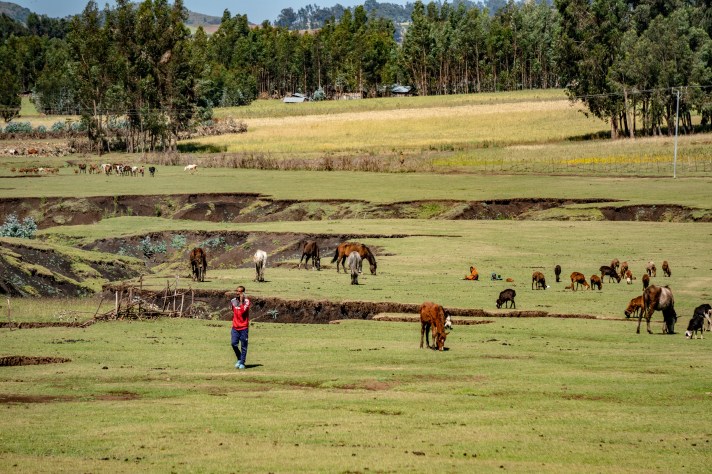
Out of nowhere, our driver veered off the trail and started making his way across someone’s field as it was the quicker route. Although there were no crops on the field I could not help but think the owner would be none too impressed if he saw the young tuk-tuk driver speeding through his land. Just before we arrived in Quha Zab-Zaba, the trail narrowed again and led to a very steep and muddy climb that had a gaping hole about halfway up. I saw it from a distance and figured there was no way in hell this machine would make the climb, certainly not with this many people in it. As Zin was the only person in the tuk-tuk who could speak any English, I didn’t bother to ask what the plan of action was. I figured we’d just stop and get ready for an unpleasant hike. I sat gobsmacked and terrified as the driver made his way hesitantly up the climb. The small and rotting engine squealed like a pig with tuberculosis and eventually – through means I will never understand – made it over the top and down the descent. It was incredible. The driver’s livelihood depended on the wellbeing of this small vessel, yet he was willing to take on a task like that as if it was nothing. Perhaps it was nothing, I thought. He may do this on a daily basis for all I know. I leaned out the side of the tuk-tuk – now that it was safe to do so – and saw that the other tuk-tuk had made it too. “Mother of God!” I exhaled, much to the confusion of Nacho and our driver. “How did he do that?!” I asked Zin, who cool as ever simply shrugged and smiled as if this was just the way things were done out here. We stopped about five minutes later and I was told that we had arrived. We were sat on a trail on the side of a shallow valley with about three to four small buildings around us. One of the building was clearly not someone’s home, as it was long and rectangular and had an Amharic flag flying over it. This was the school, which we would be visiting later that week. It’s worth baring in mind that running water did not exist this far out and electricity held as much conceptual value as wifi.
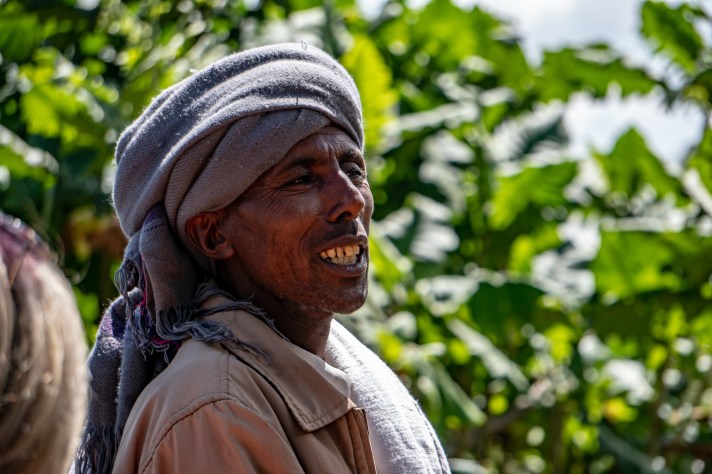
A small group of adults and children were waiting for us when we arrived, including Mesafnt. They were curious and stared in awe from a reasonable distance and none of the undesirable feelings from the day before were present. Once the meet and greet had finished, the tuk-tuk drivers took our bags and we all made our way down into the valley with our welcome committee. The ground was grassy and damp and as we got closer to the centre of the valley you could see a very faint and shallow river slowly making its way through the central crevasse. We followed the lead of the locals and Mesafnt, as they knew the best way to cross the river without ending up in it.
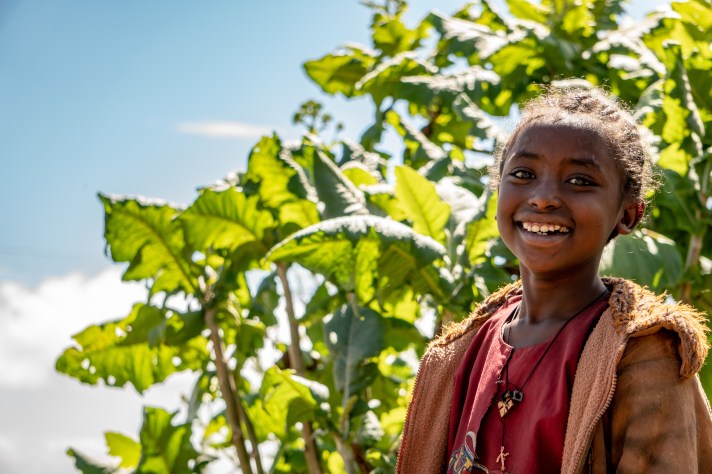
We walked through some fields that were thick with crops – carefully watching where you stood as to not ruin someone’s harvest – and made our way through some dense forestry and up a narrow and uneven path, before entering a small clearing where two houses stood about twenty feet from one another. They were square and the walls were made of wattle and daub, but they were tall and the roofs were sheet metal, protecting the occupants from the elements. They had no windows so the only light that could get in was through the narrow doorway, which was a minuscule amount. There were a few dozen people waiting in the area for our arrival and all seemed just as bemused as the people from the market the previous day. I can only assume they were expecting us however, as Mesafnt and his relatives probably informed them that we were coming
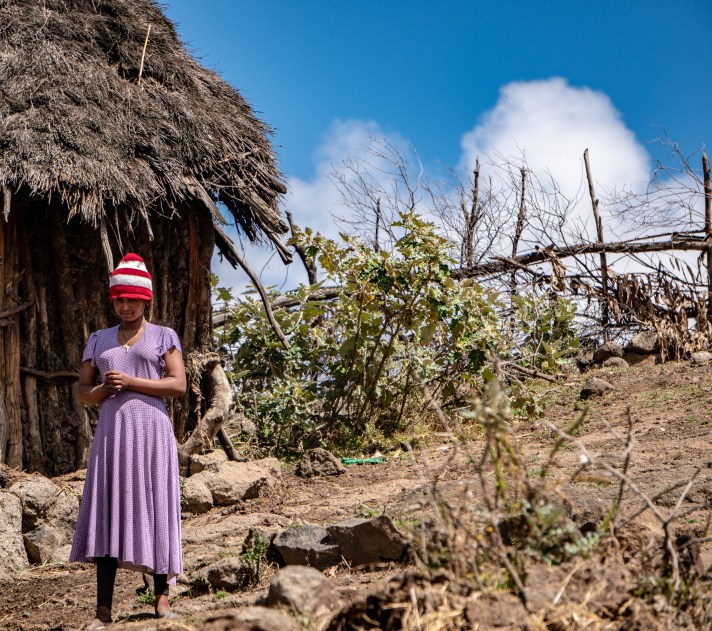
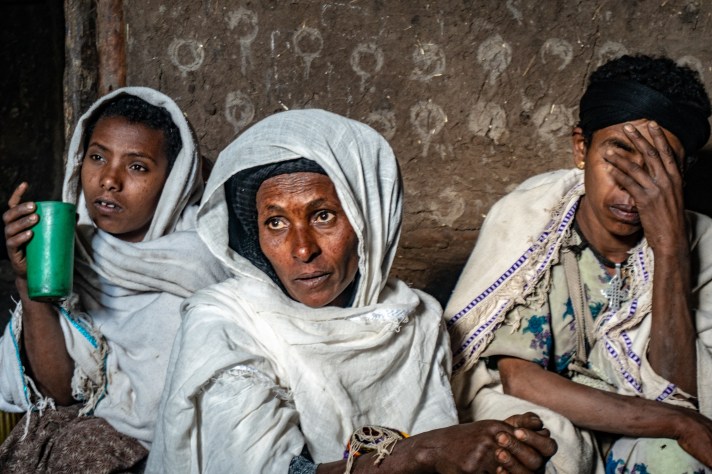
We went into the house and Niall, Elaine, the two boys and Nacho sat on a very small bench against a wall. On the far side of that wall was a room in which the animals slept, which was directly beneath the area in which the family slept. The reason for doing so is because the heat from the animals rises up, giving comfort to the family on cold nights. There was very little inside the house, just a few pieces of of handcrafted furniture, some bowls and cups, the odd wicker basket and lots of dried animal skins covering the furniture, taken out especially for the occasion. I didn’t notice them at first, but after a few minutes of sitting on a very low chair I became aware that it had an ear. The chair was so low down that I was practically sitting on the floor and the back was angled at about 70 degrees, which was like sitting in a vice-grips. The room was no bigger than that of a small newsagents in Tullamore – maybe 100 square feet – and there were about 30 of us all crammed in. We sat just inside the door with the tuk-tuk drivers, who Mesafnt – nor anyone else in the village – knew. It was just a case of it being polite for them to join us, as they would have been sitting in a field for the day if not.
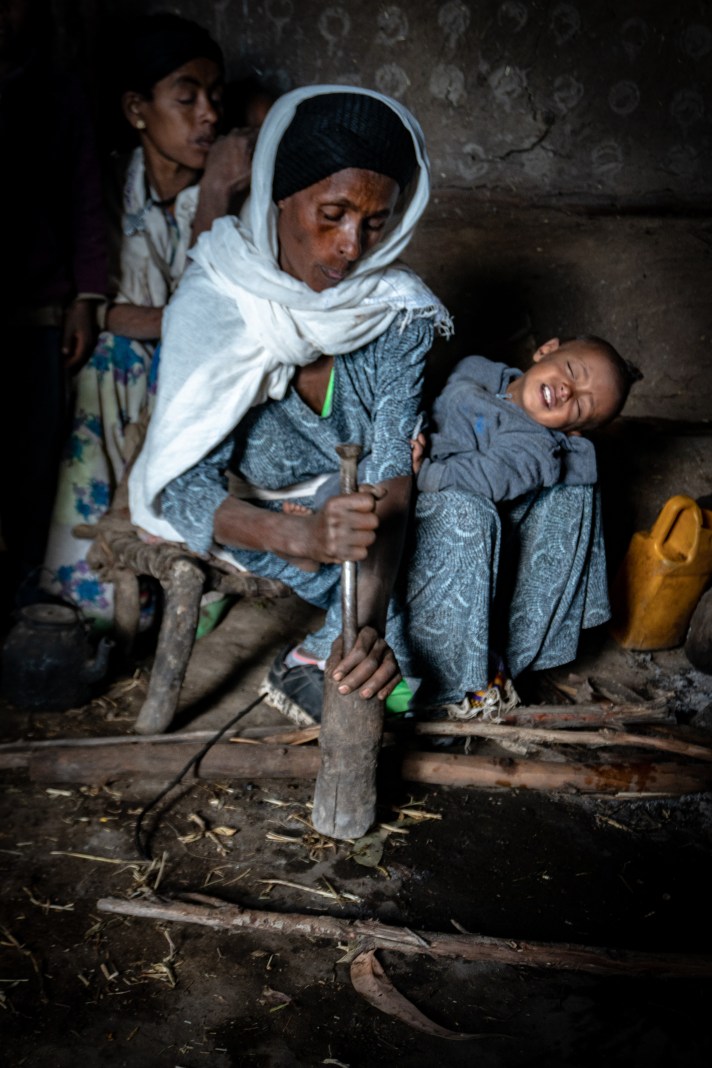
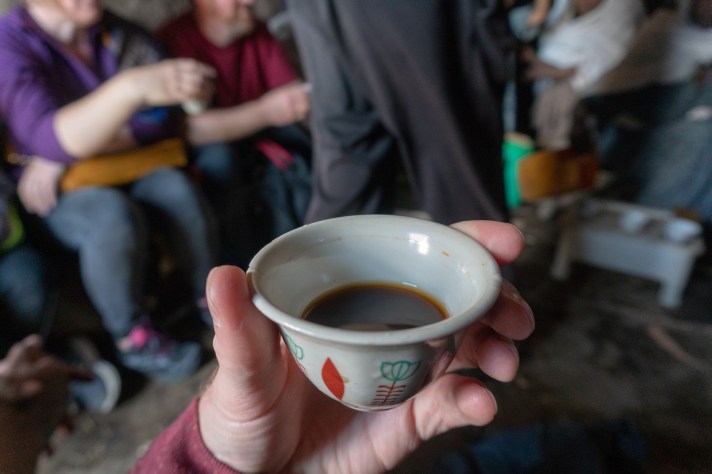
Mesafnt’s wife (whose name I cannot remember) sat in the middle of the room in front of a small makeshift fire on the floor. It was interesting to see how they fed the fire here: instead of the traditional method of breaking up wood that we are used to, they seemed to leave large branches intact and feed them in whenever the burnt end was turned to ash. She presented a serrated circle of tin – about the size of a wok – and heated it on the fire before producing a handful of raw coffee beans which she proceeded to fry on the ‘pan’ until they turned a dark brown/black colour and the room was thick with the smell of freshly roasted coffee. Once satisfied with the roast, she poured the beans into what looked like a small, hollowed out log. She then took a long, metal pike and began thrusting it at the beans inside of the log. Although fascinating, it was indeed quite unsettling to watch. She was slamming this pike at full force through a narrow gap she made with her fingers and at times did it without even looking. God knows what would happen if she missed and removed a finger. The nearest hospital is an unreachable distance away, but she was clearly well used to this. She heated a pot of water that had been acquired from the river in the valley we had crossed that morning and once satisfied with the heat, she poured the coffee grind into it. She did all of this whilst breastfeeding her infant child, which was pretty impressive. As the guests, we were all given the first few small cups of coffee. This was like no coffee I had drank before. It had a taste and purity not matched by anything I had ever experienced. It was smooth, fresh and – despite the water from which it was made – remarkably clean. It topped any coffee I know of by a country mile and I doubt I will ever consume anything like it again.
We had three cups of coffee in total, but it seemed as though it was far less caffeinated than the coffee we would be used to, because there was little-to-no noticeable high from it. Throughout the coffee ceremony, several people wandered in and out of the house. It was impossible to tell who was a relative, friend or just a passerby, but there seemed to be a good vibe emitting from everyone.
A few moments later, a man started doing the rounds of the room with a large plate of injera – a flour based flatbread that is the most quintessential piece of the Ethiopian diet. Before visiting Quaha Zab-Zaba, Zin and Elaine had advised me not to eat any of the food we were given, as hygiene was virtually non-existent when it came to food preparation this far out. Not wanting to seem ungrateful, I took a slice of the spongy injera. Zin spotted this in the corner of his eye, and before I had time to even consider eating it, he removed it from my hands and replaced it back onto the plate, looking at me with the same expression a doctor might give after resuscitating you. It wasn’t a case that the food was bad or poorly made by any means, but the bacteria that was present was of a type that our Irish stomachs would not be accustomed to, but had little to no negative effect on the Ethiopian digestive system. The Ethiopians around the room who had some injera were then given a ladleful of tibs, the traditional partner of injera. I had eaten tibs earlier in the week and was sold almost immediately. It’s a sort of hybrid of stew and stir-fry and there is very little salt, yet it is packed with flavour. The lack of salt was something that really stood out to me about the food in Ethiopia. It was strange at first, but the use of spices instead was a refreshing change. Zin ate some of his tips and said it would probably be safe enough for me to eat a small piece of the meat. I talked Niall into doing the same, as I didn’t want to be the only one. He agreed and we simultaneously ate a piece of the meat with faces that anticipated immediate regret. Expecting the worst, I was blown away by how succulent and tender the meat was, as well as the perfect blend of spices. The flavour and texture was likely due to the total lack of added chemicals and the fact that the animal was likely killed very shortly before it was cooked. My tastebuds demanded more, but my brain knew better.
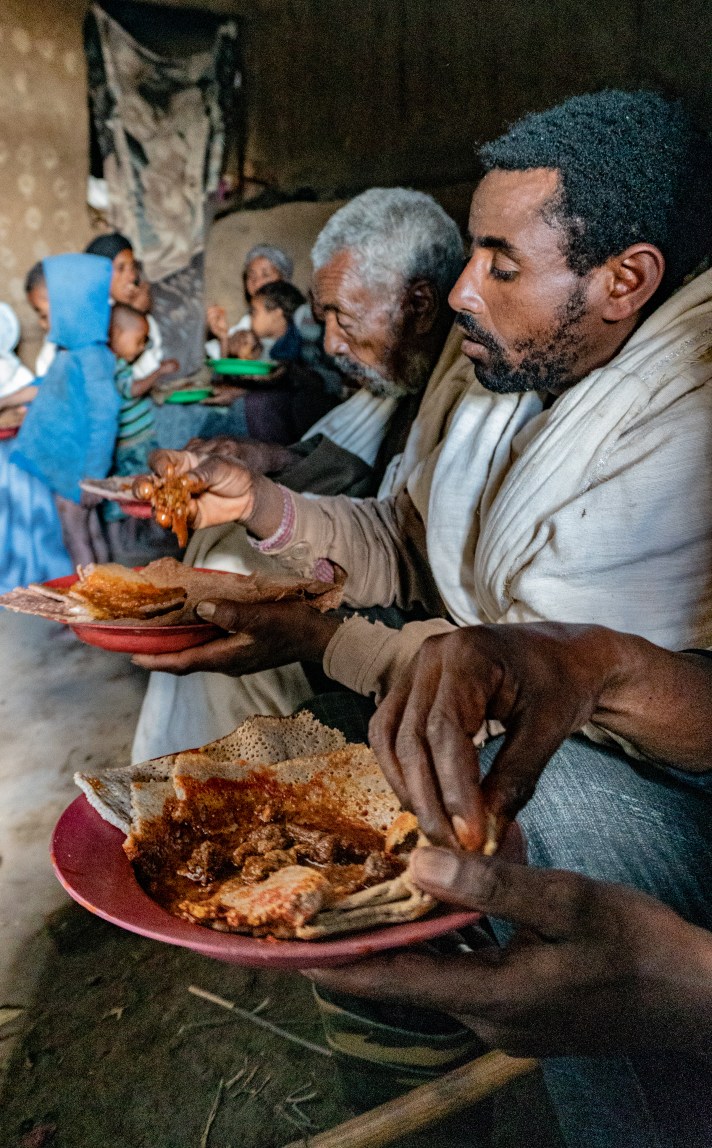
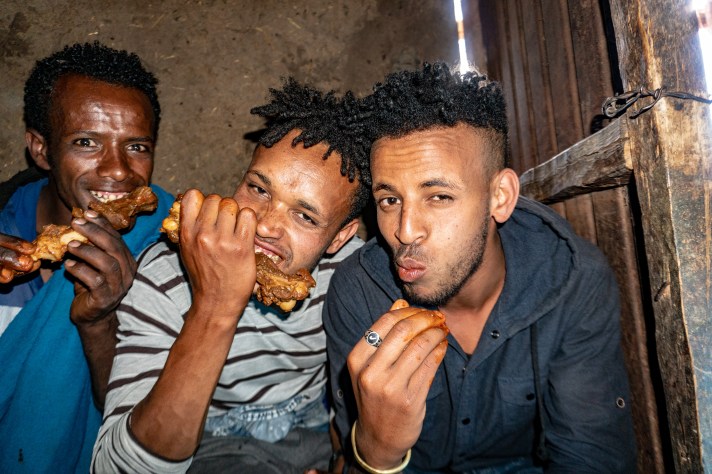
Zin and the other Ethiopians all dug in much to my envy, with the tuk-tuk drivers also enjoying their share of the meal. Towards the end, there was little left but the sauce-soaked bones of whatever animal was used. The tuk-tuk drivers feasted on the bones with the upmost pleasure until they were picked clean. I watched Godada’s husband (whose name I have also forgotten) and the tuk-tuk drivers use scattered pieces of rock to smash the bones, revealing the marrow which they sucked from the remnants. It was a hell of a sight and I admired their resourcefulness, although the feeling of food envy withered somewhat.
After lunch, Niall, the two boys and I walked up a small hill beside the house, which leads you onto a long cliff edge overlooking some of the Simien Mountain area. The view was outrageous – probably the most so out of all the views I had seen so far. Hundreds of miles of valleys and hills with a drop of about five-hundred meters down. If you looked closely, you could also see tiny houses scattered aimlessly around the landscape, with no obvious signs of trails or paths connecting them to any village or town. They were just sort of, ‘there.’ During this wander about, even more children and adults from neighbouring villages and settlements had come over to see what all the excitement was about. I started taking some photos, which attracted a great deal of attention from the children and adults alike. Seeing photos of themselves drew astonishment from them, as many of the children may have never seen their own reflection before. Before the trip, I had borrowed a Polaroid camera from a friend of mine. I figured it would be great if I could give some of the folk here some photos of themselves and their family, so polaroids were the obvious choice. I took a few photos with it and passed them around, doing my best to explain the concept using hand gestures and facial expressions. The confusion in some of the faces at the thin piece of plastic began emerging from the side of the camera was mesmerising, as too was the excitement it brought when they could not only see a photo of themselves, but be able to take it home too.
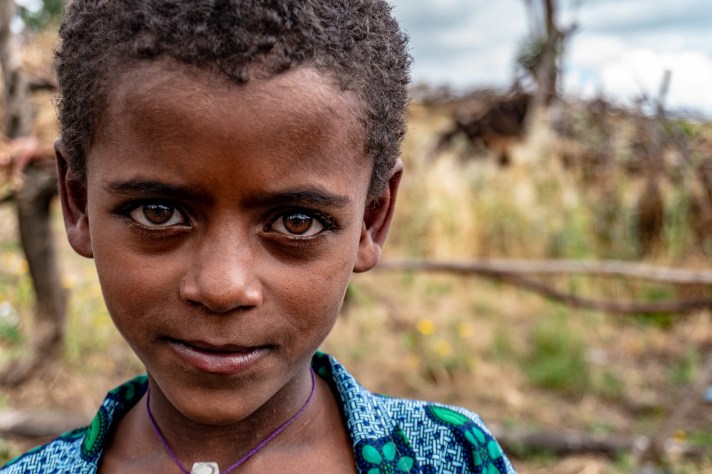
After a few minutes of photos, large crowds began to form around. Unfortunately, as with polaroids, I was limited to the number of photos I could take. I brought 10 prints with me and had used up four in that cliffside session, so I put the camera away and switched back to the Sony to preserve the polaroids. I continued to take photos of the now 100 person group, but many grew confused as to why I could not give them a photo, despite their friend getting one just moments ago. I recalled the lesson I learnt in Gonder about giving children money, but this was far harder to explain with an even tougher language barrier. While all this was going on, Elaine and Zin were inside Mesafnt’s house giving gifts to Mesafnt, Godada and their respective partners. Niall and I had volunteered to stay outside, as the gift exchange was receiving a substantial amount of unwarranted attention from the growing hoards of children. Distracting the children was enjoyable at first, but the constant hand shaking, kissing, flocking and requests for photos was becoming increasingly disconcerting. This went on to the point where Niall and I were beginning to get rather nervous, so we went back to the house to see what the story was. We arrived to find another large group of children still trying to get into the house, but there was no distracting them. We left with our own hoards so as not to add to the disorder that was brewing.
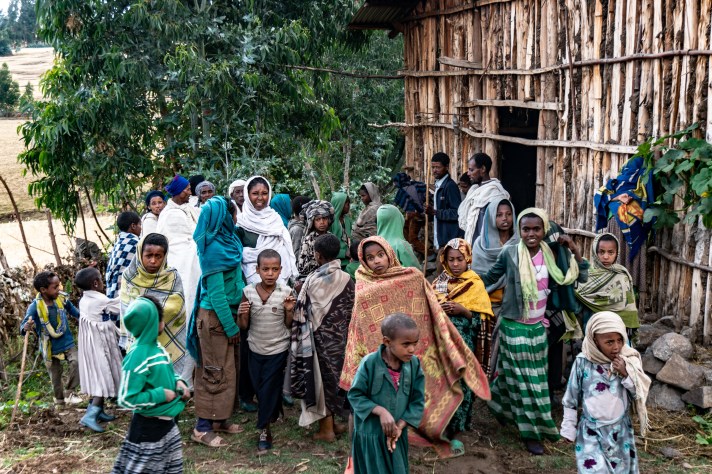
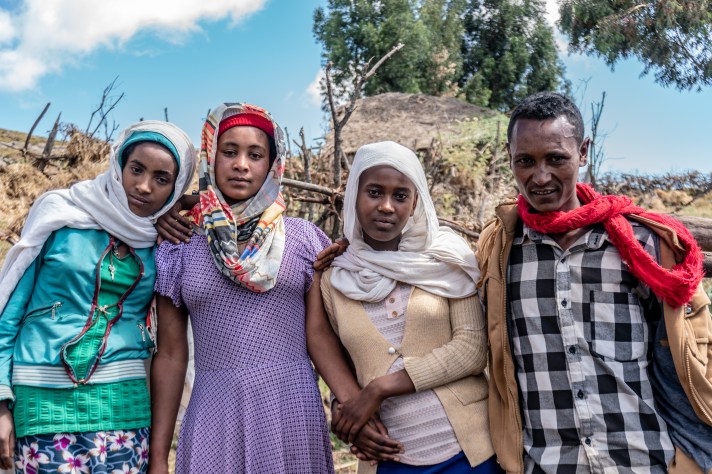
One of the adults who was in Mesafnt’s house during the coffee ceremony approached me through the mass of children and started talking to me in Amharic. He was full of smiles and wore a tan coat with a black and white checkered cotton shirt, but was most identifiable by the fancy red scarf he wore around his neck and sometimes on his head. He kept smiling and chatting away to me, but since I couldn’t understand him I was only able to nod, smile and occasionally say “yeah, yeah” enthusiastically. As time passed so did the uneasiness of the situation. The children were still flocking in the masses and the man with the fancy red scarf insisted on talking to me wherever I went. He would also do this peculiar thing with his hands, where he would make a light fist, gently hit himself in the forehead and then cusp the fisted hand into the palm of the other before finally kissing it. With Zin preoccupied I could not ask this man what he was doing, but whatever it was seemed to make him happy.
Eventually Elaine and Zin emerged from the now swarmed house and we all made our way back to the tuks with crowds of people following us. Everything was still pretty calm, but one could not ignore the sense of chaos that was gradually looming, no doubt provoked by our presence. By this time everyone wanted to go home, so there was no loitering about as we got straight into the tuks and headed off, pursued by a handful of children confident in their athleticism.
I was back in the same tuk-tuk as before with Zin and Nacho, but Mesafnt also joined us as he needed a lift into town. We were all pretty jaded so I didn’t take much in on the way home, apart from an incident involving a few young men who stopped us on the way back. The tuk-tuk was desperately trying to get up a hill and the four men kept holding it back. Zin and the driver exchanged some words with these mischief merchants and although I could not understand what was said, I knew it was not good conversation. The vibes were bad and I could sense something was wrong. Nacho, who was sitting on the inside-most seat of the tuk-tuk emerged from the shadows and started talking very sternly with the men. Their moods changed when they saw Nacho and after a few brief words and a handshake they went on their way. I didn’t ask what had happened, but later that day Zin confessed that they were talking about robbing the tuk-tuk. Thankfully Nacho was with us, and the Debark local was known to these men as someone who was not to be messed with. It wasn’t a common occurrence by any means and they were far from professional criminals, just a group of young farmers’ sons who saw an opportunity. Once we entered the large clearing – where the driver had gone cross-country earlier – the two drivers began drag racing each other back to Debark. It was the sort of driving that you would to see in Kinsealy after dark, but the adrenaline combined with early 2000’s rap music blaring through a cheap, grainy speaker in the front seat made for a thrilling ride home, which our driver won.
It was a strange day indeed. I got to see the full extent of the other side of the life spectrum. People who lived in a reality that would never surprise me again, nor would anything in between. I pondered the events that had unfolded over a feed of tibs and Habesha that evening in the restaurant of another hotel in Debark. We were all very tired so conversation was scarce. We had experienced a mind-opening and thought-provoking day that sat on our shoulders like a bad secret. We walked back to the Sona after sundown and stopped for a brief moment to gaze at the night’s sky. As we were so close to the equator, the half moon sat on its side, like a smiling face without eyes and the stars were so bright that with a little bit of a stretch, you could almost touch them. Knowing that we would be visiting the school beside Quha Zab-Zaba tomorrow was a challenging thought, but it was something that had to be done. There was little now that was going to catch us off guard and although we far from accustomed, day by day this wild world was beginning to make a bit more sense to us.
Full gallery of images from the aforementioned day below.


