*If this is your first time reading the ‘Where the Happy Folk Live’ series, it is recommended you read Part 1 first.
Long drive back to Gonder… A brunch like no other… Mass food poisoning… Oil merchants, fishermen and extortionate beer…
…excuse the lack of photos; I ran out of card space.
To preach about ‘perspective’ in a world like this is far too lazy for those of us who have come to understand precisely what that word means. It implies that we who come from fortunate existence and wealthy worlds beyond the imaginations of those around us must resign to the idea that we should feel somewhat grateful for the lives in which we have been so unfortunate to endure. That we should take pity in those less materialistically rich and be humble in our elaborate abode. Indeed, perspective is a trade often deemed virtuous by those who have not yet experienced the true torture and despair a western mind wields. “I’d say it really puts things into perspective.” A tone that echoes through my aging skull like a trombone clattering down a flight of stairs. There is no perspective in a place like this. There is only envy and hopelessness. Not the sort of hopelessness that often lingers on the minds of those who consider Ethiopia a third-world country, but the kind of hopelessness that those of us cursed with the bane of a western life only truly consider once it is far too late to conquer.
Our time in Debark had come to an end and we awoke early to make haste for Gonder. By the time I was up and ready to go, Elaine had engaged in harsh conversation with Gurma about some issues that arose with our check-out bill. I had noticed some disdain from him the evening previous, but whatever she said to him obviously provoked some sort of compassion, as he was noticeably more enthusiastic about our presence on that cold, windy morning.
Upon checkout, Gurma presented us all with small gifts – tokens of appreciation of our stay. He handed me a small, brass bracelet with a cross for the centrepiece. All of the arms of the cross were roughly the same size, but every so slightly different in shape – just enough to realise it was indeed moulded by hand. Earlier in the week I had taken a shining to the branded ‘Habesha’ beer glasses, so that morning I asked Gurma if he knew where I could get one. He told me that they weren’t available to the general public (which I did not believe for a moment) but that he could sell me a box of six of them for the humble price of just 150 birr (about €14) – an offer I simply could not refuse. We finished our breakfast with haste and sat spaciously in the same SUV that had brought us to Debark just over a week ago. Most of us nodded off during the trip. The oddities that struck me as mind-blowing and bizarre on the first journey did not startle me as much this time; crooked Mosque towers, makeshift trading posts and articulated trucks motored by actual horses all seemed fairly standard now. This was simply how things were done here. No point in questioning it anymore.
We got to Gonder mid-afternoon and checked back into the beloved Florida International Hotel. Everyone was feeling pretty jaded at this stage. We had been gallivanting on some quest or another every day until now, so our weak, pasty bodies had decided to fold their hands. Even Zin – a man constantly oozing with positive energy – was looking rough. Whatever Niall had consumed the night before was showing clear signs of immense dissent towards him. His brow was whiter than snow and his eyes consisted merely of sharp slits on either side of his nose.
After some very productive lounging in self-pity, we headed down the street to find some food. We stumbled like men returning from a harsh Siberian war into the ‘burger and pizza joint’ and sat down to look at the menu. As moods were low and faces were slumped, we took great joy in the English translations. The standout performance was definitely the ‘vegetarian pizza with meat’, which brought so much laughter and curiosity that I had no choice but to order it. We all ordered our food from a waitress who didn’t seem to understand anything we were saying, but we were confident in her ability after we all pointed to exactly what we wanted on the menu. Zin was running late and wasn’t present to translate for us. We were waiting for about 40 minutes by the time Zin had joined us, and the atmosphere at the table was bleak. No one had said anything for about 15 minutes when Zin arrived. He read the table well and went straight into the restaurant to place his own order. Morale took a major blow when it was revealed that the waitress who had taken our order had not, in fact, taken our order at all. Niall, whose body was almost completed consumed by a bad dose of dread put on his sunglasses, stood up and simply walked away. Not a word. It was momentous.
The rest of us were too desperate for food and the hotel’s service was too inconsistent to take the risk of waiting, so we persevered. Zin went back inside to express his upset, which I can only presume to have worked as we got our food shortly afterwards. The vegetarian pizza with meat was, indeed, a vegetarian pizza with meat. I’m not sure what meat it was, but at that stage, they could have served me repurposed tyres and I would have devoured it in a matter of seconds.
I had spoken to Zin the day before about how I wouldn’t mind seeing a bit more of Gonder before we left. It was likely I wouldn’t be here for quite some time, so I was keen to see the sights. He said he’d bring me to the famous Gonder Castle later that evening and that we could check out the market the next morning. At this stage, everyone apart from Zin and I had been taken out with some sort of bug. Stomachs and bowels alike had thrown in the towel, but somehow my innards were still reasonably intact – likely thanks to the abuse Habesha beer and the overindulgence in Spanish painkillers.
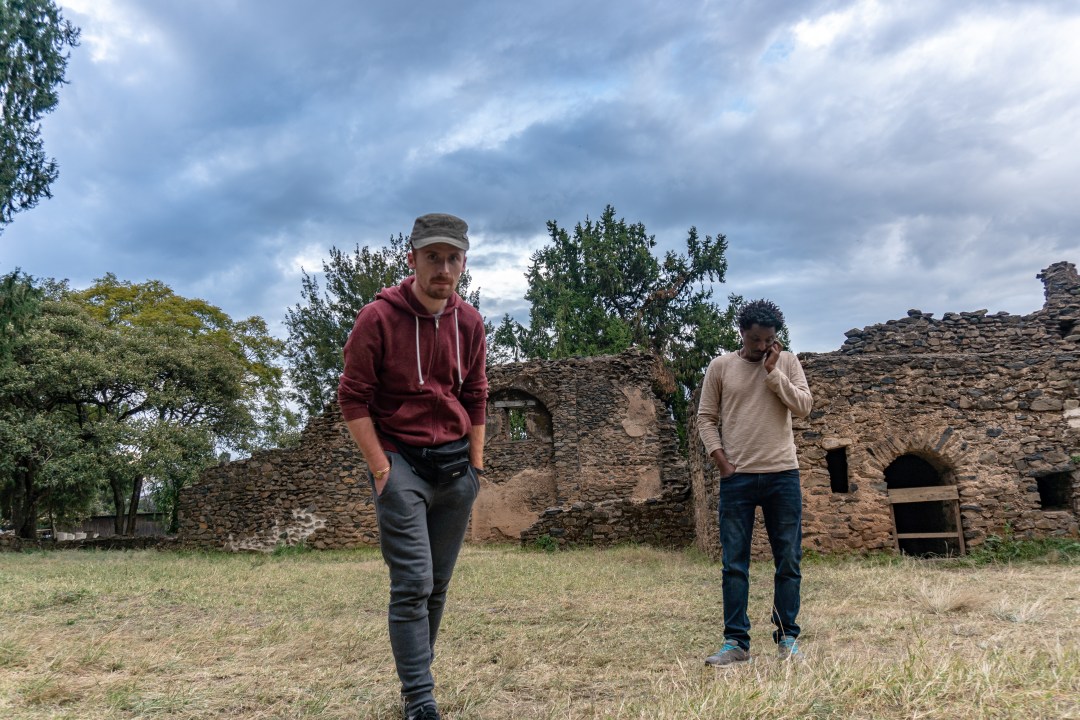
It was early evening when Zin and I headed out to the castle. There was a beautiful African sunset preparing itself to the west, but due to the enormous layout of the castle grounds, it was hard to get a good view. I paid an extortionate amount for a guided tour but was pleasantly surprised at how enjoyable the tour was. The castle’s history spanned centuries and homed many famous and infamous rulers. Its final stand was during the second world war when Mussolini’s band of merry men were using it as a fortress in northern Abyssinia and Churchill decided to blow the ever-loving shit out of it. The Ethiopians restored as much as they could, but the tour guide told me that some of the damage was simply too immense to rebuild.


The ride back to the hotel was wholesome. I felt I had developed a very close bond with Zin, despite having met him merely 10 days ago. We hit some heavy traffic and got talking about things like girls and sports. We passed the University and I was amazed to see how westernised many of the students leaving school looked. Young men with sharp haircuts, clean Nikes and smart leather satchels walked with girls wearing fitted jeans and holding their iPhones. Of course, there was no confusion about where we were, but the contrast between Gonder and Debark was almost as great as the contrast between Gonder and any European capital city. This seemed strange to me, but I was too tired to figure out why.
By the time we got back to the hotel, darkness had cloaked the Amharic city. It wasn’t until we were halfway up the steps to the hotel that we noticed several well-dressed soldiers guarding the entrance with rifles. It wasn’t as shocking as it should have been – probably because men with guns was a pretty common sight by now – so we continued into the hotel. The floor of the lobby was decorated in long blades of grass and the staff were all decked out in their finest attire. Clearly there was a special event taking place, but I was too tired to investigate. Zin later informed me that a very famous Ethiopian singer and his entourage were staying in the hotel that night, hence the big effort.
Zin said he was going out to meet a friend of his for dinner, so I headed up to the rest of the party’s room to see if anyone was still alive. Niall and Elaine were both pretty vacant looking, but overall the mood had improved and we were all hungry. There was far too much commotion in the hotel restaurant (thanks to our singer friend), so we settled on room service. Nobody had much to say and it was possibly the first night that not a single card game took place. I had a fairly inoffensive chicken stir fry and headed to my room shortly after. I got into bed, drank some Habesha and passed out watching the latest Fantastic Four film dubbed in Arabic.
The following morning was mild and spirits were high. Stomach bugs had slept in so everyone was feeling a lot better, but the family needed to pack so Zin and I headed out to the market by ourselves. Our taxi to the airport wasn’t until later that afternoon so we had plenty of time to kill, cook and eat. Zin told me we were going to meet an old friend of his for a sort of ‘brunch’ before the market, which I was cool with. My first introduction to ‘Chali’ was seeing him leaning out of a tuk going about 60 kilometres an hour past the hotel; waiving and howling at us like an over-excited fanboy. We caught up with the tuk and I was bundled into the back beside him. He was a very attractive young man with an insultingly perfect hairline and wore a red shirt with a black leather jacket. He spoke excellent English and it was refreshing to speak with another Ethiopian fluidly. We drove dangerously to a bank where Zin had some matters to take care of. Chali and I got to know each other in the seating area of the bank while Zin ran his errands. He was a firefighter at Gonder airport and knew Zin from their time together in University.
Zin finished up his business and the three of us shuffled through a rare break in traffic across the street into an open-plan restaurant. We sat under a large canopy in area slightly higher than the rest of the layout. The benches were covered in hide and the floor was splashed in the same grassy decor as the hotel the night before. This seemed to be a very traditional restaurant and not a place designed for tourists. The served only tibs and injera and the food was prepared in plain sight by three men hacking large pieces of meat with sharp machetes. Chali and Zin were going to be sharing tibs, but Zin advised I sat it out as the meat was completely raw. Despite it looking deliciously succulent and juicy, I took his advice.
Before the food arrived, Chali jumped up and started waving frantically into the crowd outside. A very tall, muscular man emerged from the crowd in response to Chali’s call and joined us. Zin knew him too and the three of them all embraced one another. I can’t remember his name and he spoke virtually no English, but the three of them made a good effort to include me in their conversations. Luckily for me, the strong man wasn’t into the whole raw meat scene either, so the two of us shared a portion of tibs that was cooked and mixed with spices. We finished up our meal and the strong man said his goodbyes and disappeared back into the crowd. Zin, Chali and I headed out to catch a tuk to the market in the blazing African sunshine of midday.
The market was everything I expected and more. A winding avenue blocked with traffic for miles to see, diluted with thousands of Habesha hustlers climbing over car bonnets, waving their hands and driving hard bargains. It was impossible to isolate a single sound in this jungle of noise and the armada of cars, tuks, wagons and lorries looked like they hadn’t moved in decades. Any inch of space on what was left of the road was battled for. The only hierarchy was based on who could claim a space the fastest. I followed by two habesha comrades through a haze of stalls all stacked up like lego and sprawling onto the muddy streets. My glaring white skin drew a great deal of attention from hopeful sellers with enticing deals and desperate eyes, whilst Zin and Chali warned me to be wary of pickpockets. I bought a counterfeit Ethiopian national football jersey and a silk shawl from a pair of Muslim men and the three of uses headed off the beaten track into some side streets. We entered an alley that was lined with women in blankets hunched over large opened sacks of raw coffee beans. They seemed to be picking them, bean by bean and separating them into different sacks. Zin told me they were separating any bad beans and making up smaller, more commercially friendly bags of coffee beans. It was far from a glamorous job, but opportunities for women seemed few and far between in the workforce. We bought some beans from the seller and came to the conclusion that we were finished with the market, so we walked a little further away from the market district to get a ride in a place where the roads were less jammed.
Zin and I hopped out at the hotel and Chali stayed in the tuk as he was heading to work. We said our goodbyes and met with Niall, Elaine and the two boys in the hotel lobby. Zin and I had packed before heading out that morning so we had already dropped our things down to the lobby and together, as a party of 6, we waited for our taxi to the airport.
Our taxi arrived about an hour early and came in the form of a rusty pickup truck held together with bungee cords. The 6 of us crammed into the four-seater with the driver, who was definitely not a taxi driver, and our luggage was squashed into the back, held down with rope and whatever other materials the concierge could find.
The next few hours were pretty brutal. We got to Gonder airport and had to wait for about 3 hours in a terminal built with the same schematics as an industrial oven. We sat around a table in the canteen and drank about 400 litres of water. The chairs were too rugged for napping and the sweat sat on our skin like a layer of yoghurt. Things were ugly. Gonder had gotten the better of us.
By the time our flight arrived, there was very little talking. We all smelled pretty disgusting and were in dire need of sleep – not to mention the fact that one of the boys and I were the only ones not plagued by severe bowel disdain. As we were walking across the runway to our plane, a familiar sight of Chali leaning out of a speeding vehicle and shouting ecstatically at us appeared. This time, however, he was riding shotgun in a large fire engine and wearing thick, fireman’s overalls. He seemed as jolly as he was earlier that day, but given how unbelievably warm he must have been, I cannot fathom how that could have been.
As soon as I sat down on the plane I was out cold and didn’t wake up until the landing gear smashed against the runway in Addis Ababa. I didn’t get to see much of Addis on our ride to the hotel. The arrivals terminal was as sad as I remembered and the cab to our hotel was brief. The family was staying for another two nights, as they were planning on taking part – avec Zin – in a sort of marathon/fun run event taking place in the capital the following day. I, on the other hand, had no place here and was booked to return to Ireland 7 hours after landing in Addis. I saw no sense in staying in the airport for that long, so I decided to join the others in the hotel for the evening before my flight.
We didn’t get up to much; Niall, Elaine and the two boys headed out to register for the following day’s event, while Zin and I napped and had dinner in the hotel. I spent a lot of time staring out the 5th story window at the hotel’s surroundings. The hotel itself was very luxurious; by far the most advanced thing I had seen so far. Minus the exterior, the building could well have upheld a 5-star status in any part of the Western world, with fancy carpets, space-age light features in the bathrooms and even a rooftop swimming pool. I stood at the window of one of the bedrooms by myself. I had aged a lot. I leaned my tired and dreadful head against the window, the stale sweat on my brow creating enough friction to keep it in place. I stared down at the narrow street below. Dozens of muddy shacks and small children wearing torn rags and spiky ribs stared up at me. I waved, but I was too high up for anyone to really get a good look at me. The strikingly desperate contrast in wealth in this exact moment was like nothing I had seen before. It wasn’t like Debark or Gonder, and despite what many will tell you, it was not like anything you would find in the west. This is what poverty looked like, and it was staring me right in the eye.
The time came for emotional goodbyes. It had been a long 11 days with the group, and we had bonded on a level deeper than that of our genetic relationship. Indeed, Elaine was more than just my mother’s cousin and Niall was more than just her husband. They were friends for life. Their sons, of course, were probably the closest things to children I will have for a very long time. I watched over them, reassured them and learned so much from them. Not many people get to see inside the minds of children in such a demanding environment, and I was honoured to be a part of their experience. As for Zinabu? Well, what can I say? He is a man of true honour and integrity and holds no ulterior motives. He is a man not burdened with grudges or resentment, but a man made up of only compassion and love. He went from being someone I did not know from a far away land to a best friend, one I hope to cherish for a long, long time.
We hugged, kissed and laughed, and by the time I had taken Addis in again, I was already back at the airport. I stood in line at the bag drop for some time. The departures area seemed a lot more advanced and modern than the arrivals, as is very often the case. The room was wide and tall and all the walls were clean and white. I got talking to a young woman from Liverpool who was clearly on an adventure of some sort. She wore a pink parka and a large rucksack and had blonde hair. She told me she arrived in Addis a week ago on a connection to India where she planned on spending a month travelling, but a problem arose with her visa which took a week to amend. She said she stayed in a hostel for the first night, but strange men kept getting into bed with her. Then she had another close encounter with a seedy policeman which she also managed to avoid. Between couch surfing and sleeping in the airport, she had managed to survive her unexpected holiday in Addis and was heading off to India. I didn’t catch her name, but I hope she made it there okay.
By the time I got to my gate, the flight had been delayed by 3 hours, meaning I had 4 hours to kill. Right beside my gate in this very high-spec departures terminal was a bar, overflowing with European tourists most of whom were on stopovers. Ireland were playing New Zealand in the rugby, but I didn’t care for this. I grabbed a seat at the bar and ordered a beer. The beers were wildly expensive here, not like the usual Ethiopian prices I was accustomed to. I had to pay almost 200 birr for a pint – some 6 euro! “Outrageous,” I mumbled, as I knocked back my 7th pint. Ireland won the game and everyone lost their shit. Brits and Paddies alike shouting and roaring as if the game wasn’t a friendly and had some sort of influence on anything. I was too busy to get involved in such lunacy because I found myself talking to an Austrian man named Daniel who was on his way back from a fishing trip off the cape of South Africa. He had been drinking beside me for some time before we got talking, and was just as drunk as I was at this stage. He told me he worked in telecoms and that he didn’t have much luck in fishing. I told him I was a professional motorcycle racer just back from the world championships and he seemed to believe me. He was a short, slim man wearing a crumpled fabric shirt and had a large birthmark covering most of his drunk, drooping face. We were joined shortly after by an older man called Cliff. He was very British and stood very upright. He spoke in clear RP and was clearly better than the rest of us. Once we convinced him to get obnoxiously drunk he dropped the persona and slouched in a barstool next to us. He was on his way home from the Congo where he had been on a work trip in the oil business. Many people would have found reasons to start a pointless argument with him, but I bought him a pint and he returned the round several times over. My friends left within about half an hour of each other – both highly inebriated. By the time my gate was closing, I must have had about 16 beers. I could barely see and it was only short of a miracle that they let me on the plane.
There I sat between two strangers in the dark of night on a massive jet cruising at about a thousand kilometres an hour. I was profoundly drunk. Even still, I couldn’t help but remember the crowd of Irish and British in the bar just a couple of hours ago. Wherever I have gone in this world, people always tell me how lucky I am to be Irish. I’m told we’re the happiest bunch of people in the world, and we spread joy and laughter wherever we go. I cannot say much about the latter part of that bold hypothesis, but I know now for sure that the former is indeed a lie. We put on a face, sure. One of joy and carelessness and, dare I say, happiness, in order to hide from the demons passed unwillingly onto us from generations of “you deserve better” and “chase your dreams.” The vulgar truth of what we deem to be happiness lies far beyond the chasing of dreams and entitlement. In a life where one’s day can be ruined by getting stuck in traffic or not submitting a college assignment on time, there is no place for happiness. It does not seek sanctum in foreign holidays, nor does it assume the appearance of currency or artifacts.
We had seen what happiness looked like. We had seen it in the eyes of the people who surrounded us. We had ventured unsuspectingly and found the source of not only human beings, but raw examples of our species’ happiness. Our privilege is not the predisposed access to cheap food and free healthcare. Nor is it our safety and security in burying our heads in salaries and Instagram posts. No. Our privilege is our freedom to pretend what it means to be happy – and our inability to accept how tragically miserable we really are.
This was not a journey of charity or self-discovery. It was not a journey of agenda. I came here to document the lives of the people in a world I thought so different to ours that it is almost inconceivable to imagine. But in doing so I wound up documenting the lives of the people in the world I called home, without even realising it. I have learned far more about myself and my people than I would ever have liked. I was returning to a world where happiness is a currency with no value anymore, and coming from a world where it is the inherent foundation of everything. I was coming from the place where the happy folk lived.


Hi Evan, thanks for finishing the story. I have really enjoyed reading the whole experience you all had, and I am glad I was able to help Elaine in her quest. Ann Clancy
LikeLiked by 1 person
Thank you very much, Ann. I’m glad you’ve enjoyed it!
LikeLike