*If this is your first time reading the ‘Where the Happy Folk Live’ series, it is recommended you read Part 1 first.
I am truly embarrassed at how long it has taken to publish this volume.
And he said unto me, It is done. I am Alpha and Omega, the beginning and the end. I will give unto him that is athirst of the fountain of the water of life freely. – Revelation 21:6
I remember waking up at 7am and being startled by the unpleasant odor that was bleeding through the door from the adjacent bathroom. This wasn’t the first encounter with the odor, of course. The offensively pungent smell that dwelled within the confines of the Sona hotel toilets was a familiar presence at this stage. But this morning was different. The attitude of the fragrance was so unbearable that not even the bitter chill that stalked the streets of Debark that morning could mask it. No. There was no time for idling around my dark, windowless room that morning. I had to make haste and rid my presence of this evil, ceramic spirit.
I was the first in the party down for breakfast, so I ate in silence and jotted some gibberish onto my notepad. The breakfast room was quiet and bland, and with my room no longer being an option for early morning respite, I decided to wander around the corner and see if that small coffee house was open. To my pleasure it was indeed open, however I did not stay for long. I had just a single coffee in the space of 10 minutes, but the cold air was sure that I didn’t overstay my welcome. Although the stay was shorter than before, my mind was held under a siege of thought and curiosity. I wanted to know all about this family and their coffee establishment. Were they even a family? I had noticed before that some of the women would arrive at the house in the early hours of the morning, which could mean they perhaps live elsewhere, or just happened to be out earlier than anybody else. Does VAT – or some equally dystopian blight – exist here? If so, how is it paid? How is it even accounted for? I hadn’t seen a receipt in the most established of businesses we had visited so far; let alone a makeshift cafe operating outside somebody’s kitchen.
With these questions of their entrepreneurial ability came an unsettling curiosity of existence. A curiosity that provokes questions that one asks themselves under the fear of self-loathing and judgement. There was no way these questions would be answered. The language of transaction and smiles can only get you so far in the world. It will get you across borders and put cups of coffee in your hand, but the detail I sought was lost before it was ever craved to begin with. Was this it, for this family? Who knows how long this coffee shop has existed. Perhaps they were born into a century-old family business in Debark. Debark is where they would be born, it is where they would work and it is where they would die. Or maybe I was reading it all wrong – maybe this was a new-age progressive initiative to promote entrepreneurial women in Ethiopia? Although I held a glimmer of cautious optimism that the latter was indeed the circumstance that I was witnessing, I knew the former was more likely true. Their’s was a story that would intrigue me for years to come. It was a story I knew nothing about, only that I knew I would find myself pondering on it for some time.
I stood up, paid for my coffee, gave what was considered an extremely generous tip, and departed for the hotel. The frankincense had dwindled and the temperature continued to drop.
The rest of the party had been assembling at the rear of the hotel with Nacho and 2 tuk-tuk drivers. Not to my surprise, it was yet another set of different drivers. The drivers had always seemed very hospitable and friendly during our time in Debark, although I suspect their vehicles needed a lot of maintenance after their ravaging assaults of the Ethiopian outback.
The two government officials we had met the previous night were awaiting our arrival at the school in Quha-Zab-Zaba, so we had no reason to hang around for much longer. The drive out reminded me of riding a bike through a typical Spring day in Naul. The cold air cut through you regardless of how many layers you were wearing and although it wasn’t raining, there was a constant film of damp coating all of the hard surfaces around you.
I don’t know if it was just me, but there was a growing sense of complacency about our surroundings now. Driving cross country in a small tuk-tuk held together with string and sheer hope seemed like a perfectly normal method of transport. The jaw-dropping views of the surrounding area had also grown tired on me. The views themselves had not changed at all, but I was already beginning to take them for granted. That said, I made sure to remind myself to take one last memorable look at them on the way home, knowing that I may never see anything like it for a very long time.
We rendezvoused with the government men at the school in Quha Zab Zaba. They didn’t have much to say for themselves, but we had other business to attend to first. One of Niall and Elaine’s sons had organised a project with his classmates in Ireland in which each child would write a small personal card to the boys and girls in the school of Quha Zab Zaba. There was also the matter of distributing the very large collection of football and sports jerseys that Niall and Elaine had collected from donors. There must have been close to 100 jerseys handed out to the teachers and older boys in the school, which made for quite a remarkable sight. Dozens of excited Ethiopian boys sprinting wildly around the fields, some draped in the colours of Liverpool and Man United, and others baring the colours of Leitrim and Roscommon GAA.


Whatever way the schedules worked out, the only group of students at school that morning were older boys. This made for a calmer experience than before, as they weren’t quite as excitable as the younger generations. The area was not completely void of the younger kids though, and once we got working with the government boys on surveying the land, the crowds began to form.
The two government men were young fellows of lean build and tight haircuts. They seemed well kept and modern, which made them stand out from the locals of Quha Zab Zaba. In their possession was small computer – about the size of a smartphone although much thicker. It seemed connected via satellite – like that of a Garmin device – and was apparently used to determine the location and flow of water deep beneath the earth’s surface.


Once the expedition began, our party sort of split into all sorts of subgroups. The two boys didn’t feel up to another day of potential swarming from the school children, so Elaine and Nacho hung back at the tuks while Niall, Zin, Mesafnt and the two government men began surveying the land. Over the course of about an hour, we migrated around an area of about a kilometre, stopping at supposedly promising parts of the land where there may have been prime access to running water.
At the time, it was virtually impossible for Niall and I to follow any of the conversations that were taking place. At any given moment, you had about 5-6 Ethiopian men and women talking over one another in Amharic and making strange, sea-splitting-like gestures at the ground. Instead of trying to bother interpreting what was happening, Niall and I eventually began finding ways to entertain ourselves once the traditional Irish humour of sarcastic comments and witty remarks about our surroundings had grown stale. We decided to take it upon ourselves to keep the growing masses of children entertained and not distract the business that was taking place.
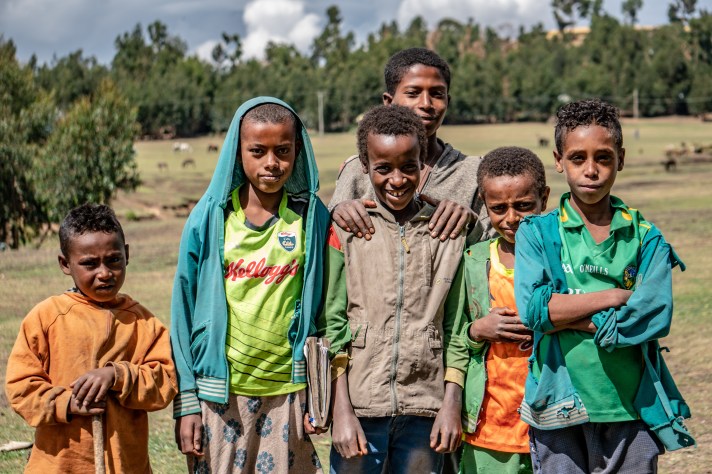
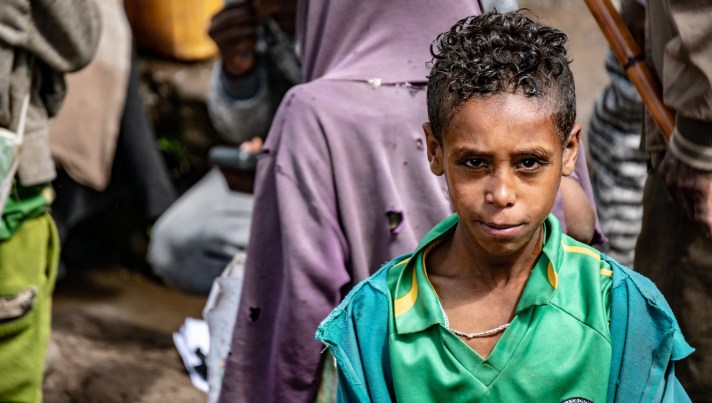
I was trying to get some shots off with my camera of the surveying party making its way along the stream, but the fascination of this process was too much for the group of 50 children that were observing my every move. I found it rather ironic that I – someone there to document what was taking place – was, in fact, the prime subject of a documentary greater than I could ever imagine.
Upon realising that keeping curious faces out of the line of sight of the camera was an uphill battle I had little chance in winning, I retired my efforts as a journalist and began my short career in childcare. Despite having no efficient way to communicate with the masses of children around me, I managed to quickly find myself at the centre of a highly entertaining game that I did not know the rules of. It seemed all I needed to do was stand up and down at will, whilst shouting “up” and “down” when I do it. It seemed alien to me. If I did such a thing with a group of children anywhere in Ireland I would attract zero enthusiasm and quickly be marched to the closest police station, or worse yet – be sectioned for acute madness. You can see a video of this madness here.
The children grew tired of this activity quicker than my imagination had time to process anything else. Thankfully Niall had a back-up. He was standing on the far side of the ravine to me and had amassed his own group of local children. Once my group saw the excitement brewing, they began to disperse, slowly at first, but once it became clear that the man with the straw hat was far more entertaining than the one with the camera, my children evacuated like the flight of the Earls.


Once I admitted defeat and realigned my allegiance, I ventured across the ravine – assisted by some children – to see just what it was that caused Niall to steal my fanbase so efficiently. He had somehow acquired one of the children’s school books and was drawing amazement by pointing out some of the objects depicted in the book and pronouncing their English meaning – to which the children would try to respond. This provoked a great deal of intrigue and humour amongst the crowds and, as far as I’m aware, Niall has since been nominated for a Pulitzer Prize in children’s literature.
Although we couldn’t make out what anyone was saying, the body language between the government men, Zin and the locals was obviously negative in tone. There seemed to be a great deal of disagreement and the shrugging of shoulders could be heard all the way from Beirut. But with little insight or any value to offer, Niall and I continued about our business in distracting the children. This was clearly no conversation for their adolescent ears, despite the likely fact they will be having the same heated talk in years to come with a different – yet strikingly similar – set of government officials. Little did they realise the harsh reality of this, and even if we did speak the language, it would have been impossible to explain it. The circumstances were difficult enough to negotiate in our own minds, let alone that of a child.
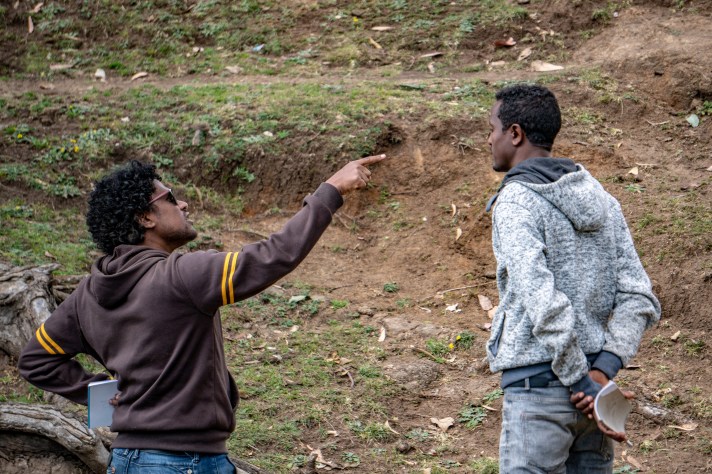
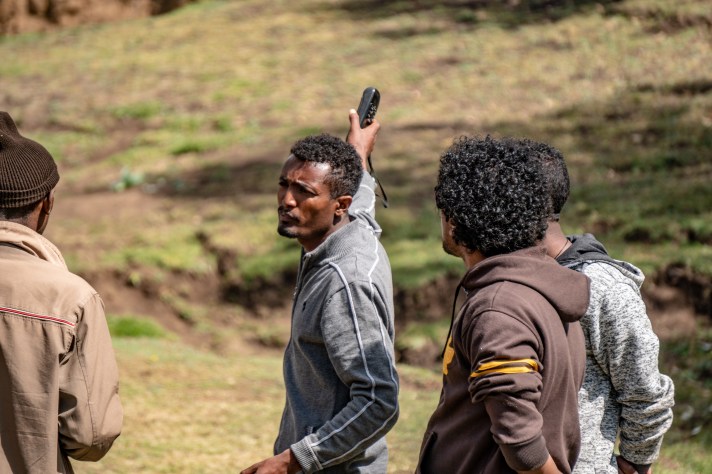
Following what I assumed to be two unsuccessful survey locations, we made our way to the third location. It lay about 500 metres in some direction as the school and was at a marginal yet noticeable lower altitude. The children were elsewhere at this point. Somewhere in the half kilometre hike across the ravine, they had lost interest in Niall and I’s antics. Our pride was certainly damaged, as we had come to realise our shelf life was dwindling with every second that passed.
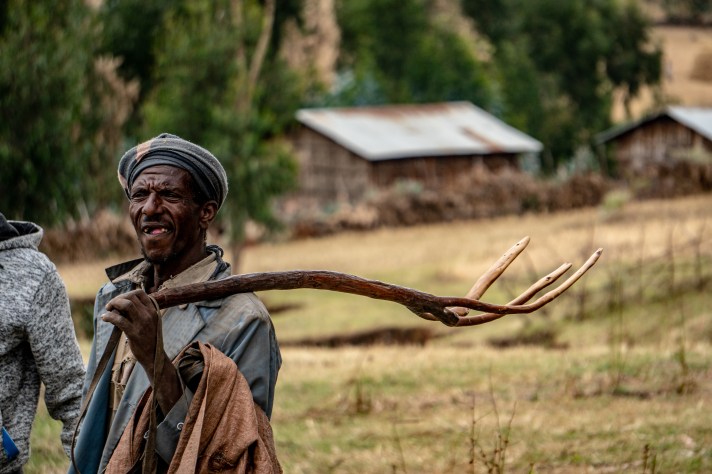
The exodus of small people opened a door which allowed Niall and I to get closer to the surveying group. The general mood seemed to have lifted slightly, and from what we could make out there was optimism in the air around this new site. As the government men and their fancy device went about their business, a couple of people from local villages approached. They exchanged conversation with our party, but I was far too distracted by the large wooden pitchfork one of the men was holding. It looked like it had grown from a tree specifically designed for its branches to assume the shape of a fork, with virtually no signs of alteration made to it. The fork was smooth and shiny and the man wore it over his shoulder – a pose adopted by almost every local man I had seen this week.
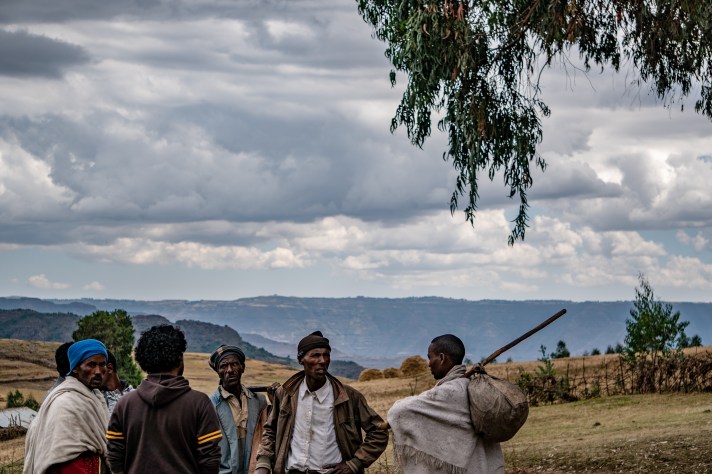
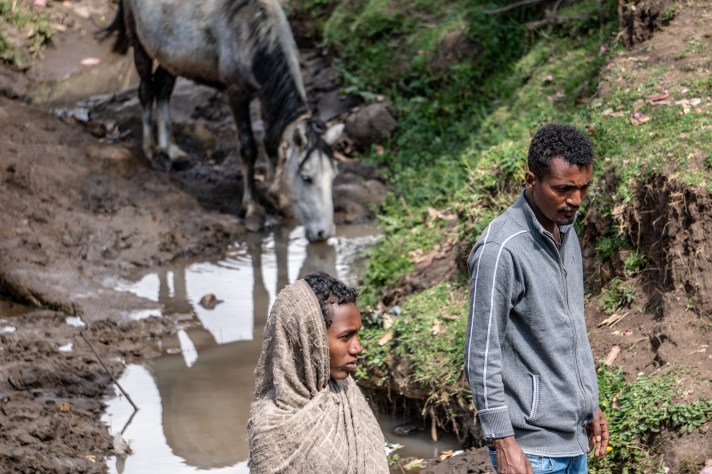
Finally, after what seems like a lifetime within the darkness of the language barrier, Zinabu gave us a rough outline of the conversations that had arisen between all of the people who came to weigh in on the surveyors’ findings. The main issue present was the watery divide that separated Quha Zab Zaba from any of the main roads. This meant that, even if water could be accessed and a pump installed, there would be no way to transport the machinery and vehicles needed to any location on the wrong side of the ravine. Similarly was the second issue; although the surveyors were confident that this last location – which was on the favourable side of the ravine – would grant access to running water, there was no way to be absolutely certain.
Ignoring these issues, there seemed to be two options available. Options that were, of course, potently occupied with the Ethiopian culture of bureaucracy I had come to know all so well.
Option one: request that the government installs the well. To any westerner, this would seem like the obvious choice. The government is there for reasons like this, so it makes rational sense that they would carry out such a chore. Alas, we are far from the West. Ethiopia – although slowly creeping closer towards a progressive future – still suffers from an incredibly bad dose of deep-rooted corruption. Corruption so deep, that whilst watching TV in the hotel bar that evening we learned that several high-ranking security officials from within the Ethiopian government had been arrested earlier that day, on charges linking them to a failed assassination attempt on the newly elected Prime Minister Abiy Ahmed earlier that year. This option seemed the least favourable – for obvious reasons.
Option two: allow the local residents to elect a committee from within to organise and negotiate a contract with a potential private company to construct the well. Despite this upside of having the entirety of the plan’s control within the hands of those who had a vested interest in seeing this project completed, there was no doubt in anyone’s mind that such levels of organisation would take months – if not years – before any noticeable action was taken.
Regardless of the individual preference, the local community of Quha Zab Zaba would meet after mass on the following Sunday to discuss the possibilities. Those of us not directly involved knew full well that ultimately, this was going to be a very long process. As we had discovered, things move at a remarkably slow pace in this world, even at the best of times. It seemed depressing that such avoidable circumstances like bureaucracy and committees would be the reason that the children Niall and I had made so many fun memories with may never have access to clean water. Hell, with the way everything else went, their children could be asking the same questions in years to come.
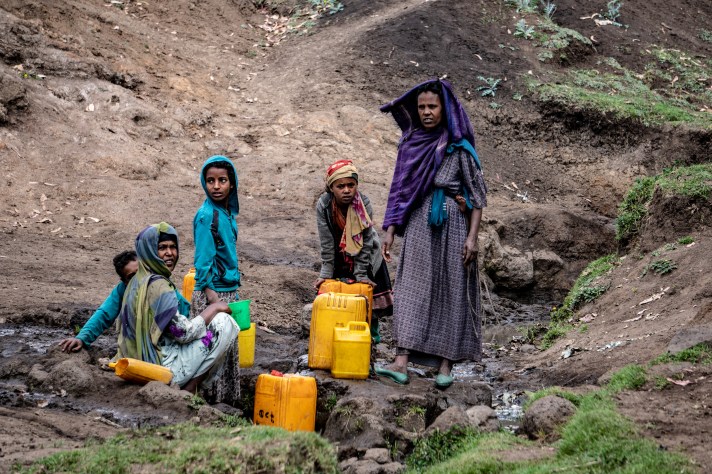
It was the last time many of us would be in Quha Zab Zaba for a long time. Tomorrow we would be making haste back to Gonder for a single night, before flying back to Addis. We said our goodbyes and shook a thousand hands. I did not know when I would be back in this village – maybe a year, maybe ten.
We got back to the hotel and enjoyed our final dinner in the Sona Hotel. Gurma was sitting at the bar speaking with another man. He was very well dressed up this evening, as was his acquaintance. Apparently, there was some sort of an event going on in the adjacent building, and Gurma was somehow involved in this.
Niall and Elaine told me that there were two government officials coming to the Sona to speak with them and Zin about the possibility of installing a well in Quha Zab Zaba. The meeting was sprung off the back of the conversation they had had with the social worker – Denis – the day before, and from the results of the surveyors’ findings. Although I would have liked to have been present for such a meeting, I offered to stay upstairs and watch over the two boys. It was unclear just how long the meeting would be and it would have been unfair to expect an eight and a nine-year-old to endure a lengthy conversation about rural Ethiopian water infrastructure exchanged through broken English and Amharic. Zin obviously needed to be there for the sake of translation and negotiation, and since Elaine and Niall would be the ones initiating a fundraiser for such an investment back in Ireland their presence was crucial.
The two boys and I played a few games of cards and talked about the different experiences of the trip so far. It was rather fascinating to listen and take in a child’s perspective of what we had encountered and the way in which they processed it. Their descriptions – although I regretfully did not note them – were brutally honest yet playfully entertaining. All far more interesting than anything I had mustered up so far. The meeting was shorter than anticipated and they filled me in over some beers and yet another hour of card games in the bar.
Tomorrow we would head back to Gonder. Zinabu said he would show me around some of the landmarks that evening, as well as a trip to the market the following morning. Our time in Debark had spared little time for hard reflection. It seemed that although everything moved very slowly, we were indeed always on the move. It was as if we had been there both 11 years and 11 hours – or somewhere in between. I was tired and drained and in truth, although I had fallen in love with this unusual corner of the world, I was ready to leave.
Full gallery of images from the aforementioned day below.


 Evan O'Gorman