*If this is your first time reading the ‘Where the Happy Folk Live’ series, it is recommended you read Part 1 first.
How am I to be creative? Nature knows only one answer to that: Through a child (the gift of love). – Jung
Monday morning was not unlike Sunday. The sun rose like clockwork and breakfast was as wholesome as before. I was one of the first people down for breakfast that morning, joined in the dining room by two young French men eating scrambled egg by the window, a member of the hotel staff who was serving coffee and a lean cat that was pottering around under the tables. The cat was friendly and not causing anybody an ounce of concern, which was a strange sight indeed. I could only imagine the reaction in most Dublin hotels if what appeared to be a stray feline moseyed in for breakfast on a crisp, Monday morning.
When we arrived back to the Sona after visiting Quha Zab Zaba yesterday, Gurma – with the assistance of Zinabu – informed me that they had moved my things to a new room. For a brief moment I was confused and bothered by this, but that was a sensation that did not lag. Following the events that had unfolded that day and the piercing exhaustion I had found myself in, the condition of the room in which I would spend the vast majority of my time sleeping was of little concern. I was in rural Ethiopia and I didn’t have to sleep a mere 4 feet above farm animals at night in order to be warm, so it was a pretty good deal all things considered.
Despite a long night’s sleep, we were all still pretty shook. A sense of fatigue and mild reluctance to revisit Quha-Zab-Zaba so soon crept around the group, but we knew this was something that had to be done. Shortly after her previous visit to Ethiopia, Elaine had formed a campaign with the hope of helping the children of Quha-Zab-Zaba and the surrounding area. Initially, the campaign was orientated around the young girls who were going through puberty about the changes in which their body was experiencing and what this meant for them. Elaine was startled by the severe lack of information available to teenage girls in the greater area and wanted to do everything possible to ensure they knew exactly what was happening and that, despite some isolated belief that this was a sign of illness, their body’s actions were totally natural.
Women’s sanitary products are virtually non-existent in this part of Ethiopia, so Elaine’s campaign was orientated around the voluntary production reusable sanitary pads. Of course, it would have been a lot easier to just ship hundreds of thousands of disposable pads over, but given there was no waste disposal in the area, such a move would no doubt lead to an epidemic of its own. What started out initially as a handful of locals in Elaine’s community putting together these pads quickly grew to a global initiative with people sending over handmade fabric pads from across the globe. The successful cooperation of volunteers resulted in us bringing over a collective 1200 reusable pads which, should they become an integral part of local society, would be instrumental in changing the lives of these young women.
The initial success of this campaign triggered an epiphany for Elaine. There they would be, handing out carefully put-together care packages for all the young women of this school while all of the young men would be going home with nothing. They had no fault to play in the culture which sees menstruation as taboo, so it made no sense to isolate them. The solution was the acquisition of as many football, GAA and other jerseys as was possible.
The combined collection led to us bringing over about 7 large bags packed tight with pads and sports jerseys. This was likely the strangest cargo I had transported and was a sight that would surely induce bludgeoning confusion in the mind of a rookie customs officer upon witnessing this.
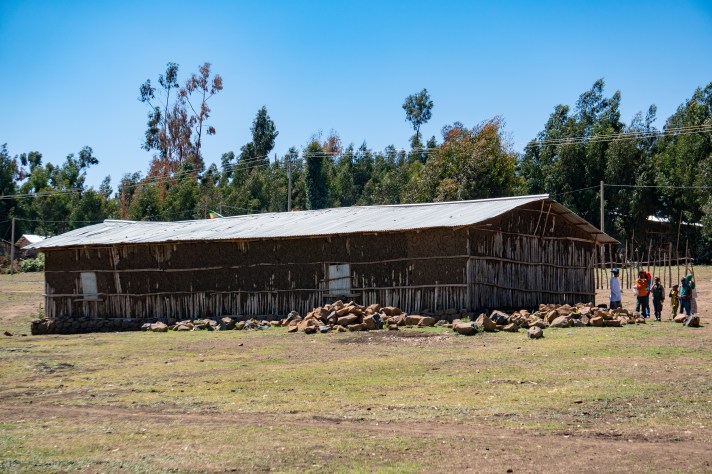
The plan today was similar enough to yesterday: we were returning to the outback village of Quha-Zab-Zaba but instead of making our way across the ravine and through several fieldfuls of crops, we would be visiting the school where our tuk-tuks had parked yesterday.
We somehow managed to squeeze in about three of the packed bags into each tuk-tuk, as well as the three or four passengers that wedged into whatever space was left free. The drive to the village was not as surprising as our first trip, but was arguable more terrifying given the added weight to the vehicles. I’m not sure how much one these contraptions weighed, but I wouldn’t fear to hedge a bet that the current cargo was of equal – if not greater – weight. At one point, as we were making our way across a large hole in the middle of the trail, the tuk-tuk became trapped in the moist, paste-like dirt, due to the heavy downpour of rain that night.
Nacho and I hopped out and pushed the tuk-tuk free, covering our shoes in thick chunks of mud.
It came as news to me that morning that we would also be joined by the local government-appointed social worker who was responsible for the school. He was a tender man of medium build and height, who was clearly better fed than most of the people in Debark. He wore a pair of jeans and causal white shirt with stripes and he travelled everywhere on a dirt bike. I enjoyed many moments of internal joy when I conjured to myself the image of social workers in Ireland scattering around the country on a convey of Fine Gael branded dirt bikes and HSE scramblers.
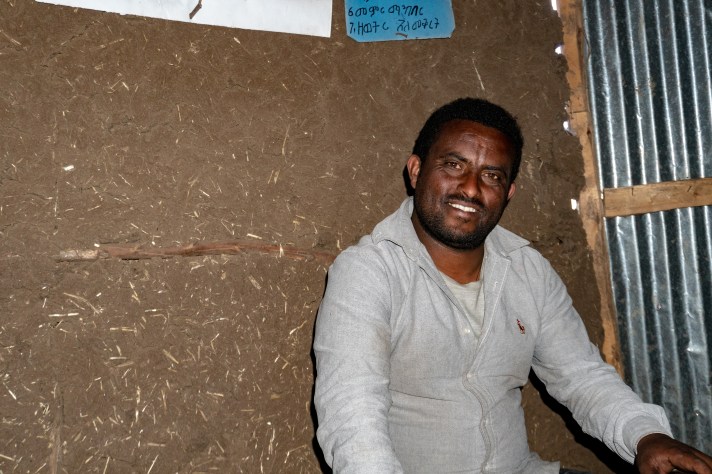
(Though I never did get his name, for the sake of the word count I will refer to him simply as Denis).
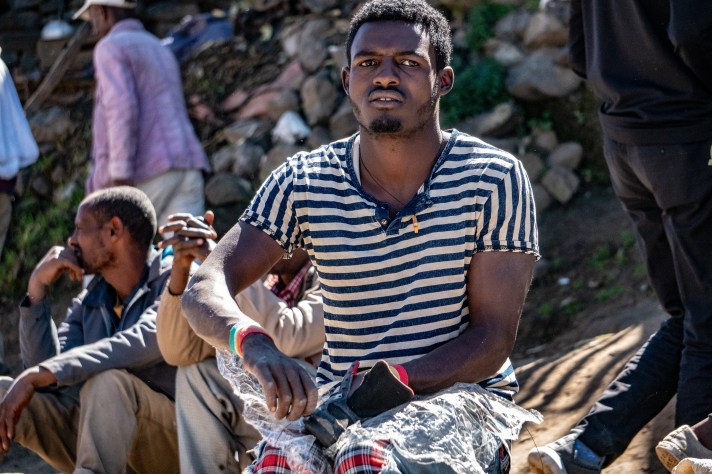
He rode ahead of us across the trails and through the trees on that bitterly cold East African dawn until we arrived at the school. Everything seemed very familiar, even though we had only been there the once before. Niall, Zin, Nacho and the two drivers began removing the bags that had been crammed deep into the backs of the tuk-tuks, while Elaine and the Denis made their way inside the school. There were about a dozen children scattered about the perimeter who, upon seeing what all the fuss was about, accumulated to form one highly intrigued group.
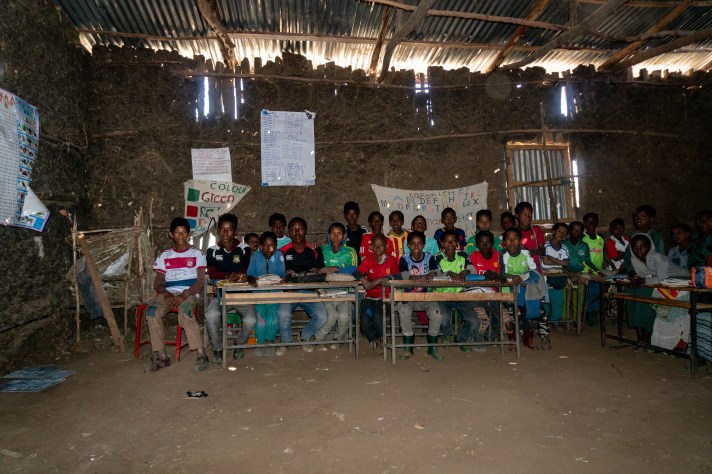
The building itself was tall enough to fit two stories, but it only had the one floor that was divided between three rooms. Elaine and Denis went into the rightmost room and once the bags had been removed from the tuk-tuks, the rest of us followed suit. The room was incredibly dark and the floor was made entirely of dirt. In fact, it was tjust a continuation of the ground outside, but the mud had been condensed over generations of footsteps that it formed a harder, solid texture.
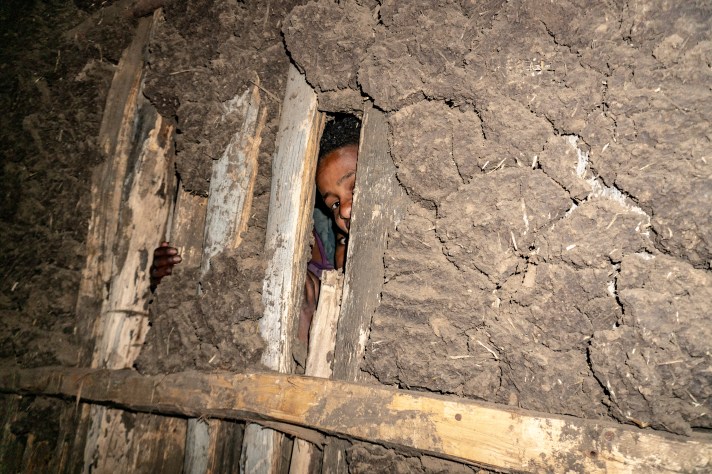
The walls were the same as Mesafnt’s house; compressed soil with nothing more than a few mildly sturdy eucalyptus branches holding the structure together. There were no windows in the school, so the interior was blindingly dark. It took a while, but once we were inside the small classroom for a couple of minutes our eyes had adjusted to the low light conditions and navigating became much easier. Elaine had an in-depth conversation with the principal of the school and Denis about what could be done to improve the lives and the resources available to the local children. I was not paying all that much attention to the conversation as I was totally immersed by the constant singing and chatting of the children in the adjacent classroom. As with the condition of the walls, there were small gaps that allowed sound and what little light there was to pierce through the different rooms. It was hard not to become totally occupied by the activities going on on the far side of that wall. You could sit and stare through this tiny hole at a room of ecstatic young children learning the alphabet, singing songs and clapping their hands with joy.
Once the conversation finished up we all headed back outside and down towards the ravine. Elaine and Niall wanted to see what the conditions of the local water supply was like, as neighbours and friends within their own Irish community had suggested the possibility of fundraising for a well to be installed.
Many of the local children had now gathered outside the school with the news of our arrival, but the numbers were nothing like that experienced the day before. There were 30 at most, and many of them were actually playing with one another in the close distance, as if the novelty of us was beginning to dim. We all made our way down to the well, carefully surveying every piece of ground we stood on. Although the area was relatively flat, the drop down to the river was wet and unsteady, and a misplaced foot could result in a very unpleasant spill.
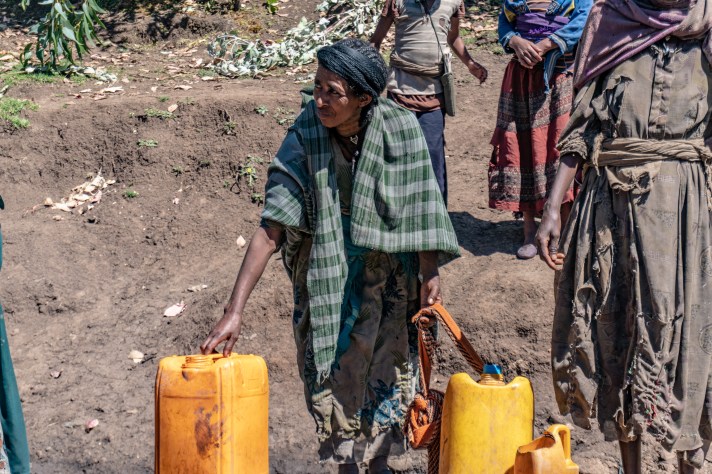
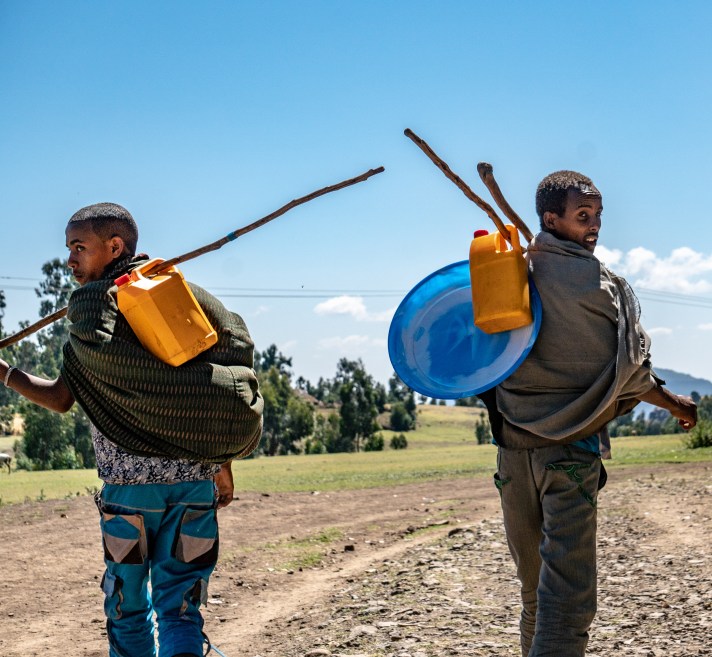
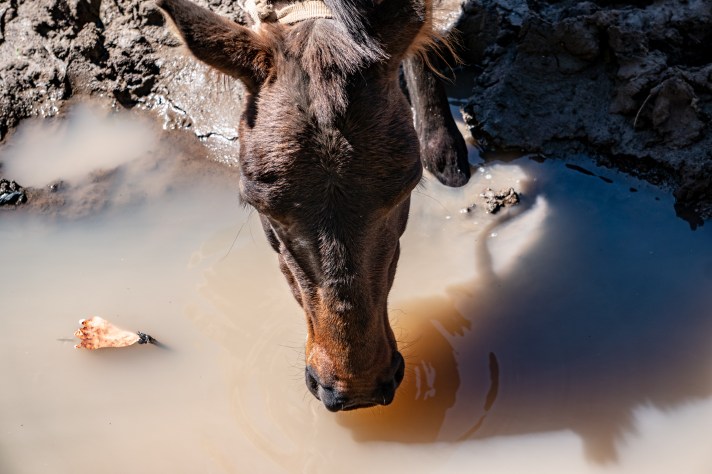
When we got to the stream, several young women were huddled around an opening, passing dirty plastic containers to one another. They were scooping the water from the very weak current, with one girl sitting right on the edge and the others passing the containers to her. This was less of a river and more of a weak trickle of water that runs parallel to a curb in suburban Dublin on a particularly wet day in mid March. It was no more than six inches deep and three feet wide.
The closer you got, the more harrowing the sight was. While Zin, Elaine, Niall and Denis chatted about the conditions, I tried my best to get as many views as possible. The reality of it all was truly dire. What little water there was in the stream was a thick, grainy consistency and not remotely transparent. It had a light brown colour and was infested with flies and other unfortunate insects. People were walking through it barefoot and at one point we learned it was not only the local villagers who utilised this valuable resources, but their farm animals and other passing wildlife also depended on this stream for hydration. This became clear when two donkeys arrived, almost like a pair of elderly women rocking up to the Merrion Hotel for some afternoon tea and gossip, and began drinking only 5 feet upstream from where the girls were extracting the water. This shook us all, even Zinabu from what I could tell.
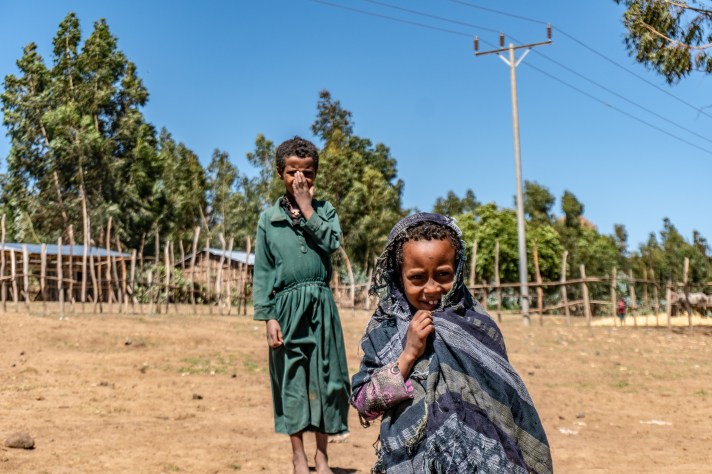
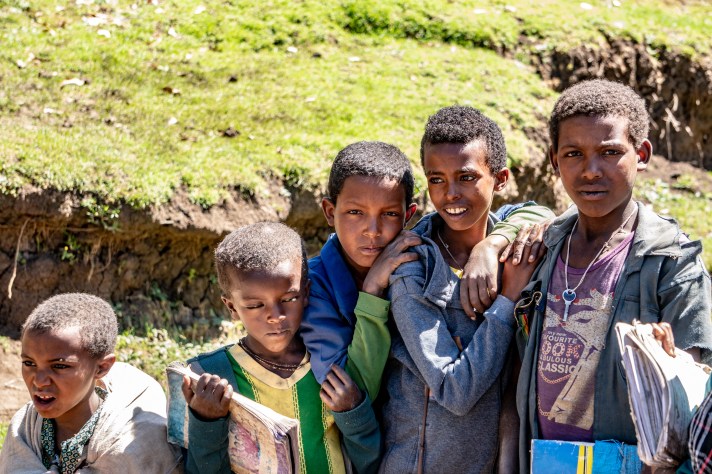
As we made our way back across the field towards the school, it became clear that a class had just finished up and the plethora of ecstatic children came galloping in no particular formation across the way towards us. They were glowing with excitement and their makeshift schoolbags and satchels bounced wildly around their narrow, malnourished frames. They stuck with us along the short walk back to the school and once you shook one child’s hand, you had better be ready for the armada of outstretched hands and orchestra of “Salam’s.”
We entertained the now several-dozen strong group as the local teachers conversed about the best way to distribute the gifts brought over by Elaine and Niall. There was no way in hell every class was squashing into the one room, that would have been unadulterated chaos. Nor would a single file line have functioned in any mannerly way. Instead, they organised the children into their different classes preemptively, and would send them in from the youngest to the oldest.
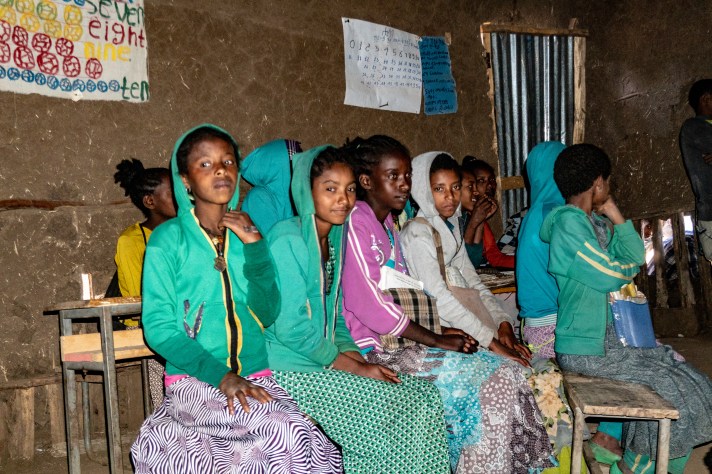
We made our way into the leftmost classroom with the teacher and the principal and once our eyes adjusted to the low light, we could see that we were joined in the room by a group of about 30 children, all quite young and in a state of anxious awe. Unlike the older children in the area or the children in Debark, there was no hyperactive excitement from the class. This was pure astonishment. It was likely they had never seen someone of our ethnicity before, and now all of a sudden there were four of us in their very classroom. I cannot imagine the sense of utter bewilderment they surely felt. It was the equivalent to sitting in Bayside National School in 2001 and seeing a cluster of blue men and women wandering into class wearing tinfoil and welding a magic black box that kept emitting a rapid, blinding flash.
The only real source of light into the room was the door, which at this point was crammed with onlookers. I assumed the children outside had been informed that they would get their turn in the spotlight, but this did not ease them. There were a few convincing efforts by some daring individuals who would try and make a break into the classroom, but the principal and Nacho were always on guard to apprehend their advance. The principal wielded a large piece of rusty metal that was bent at a 90 degree angle. I didn’t see where he acquired it, but judging by his impressive dexterity and confidence in each swing, he was clearly a well seasoned practitioner of such a tool. He didn’t actually make contact with any of the children, but the sheer sight of him swinging this improvised weapon was more than enough to discourage even the boldest of them.
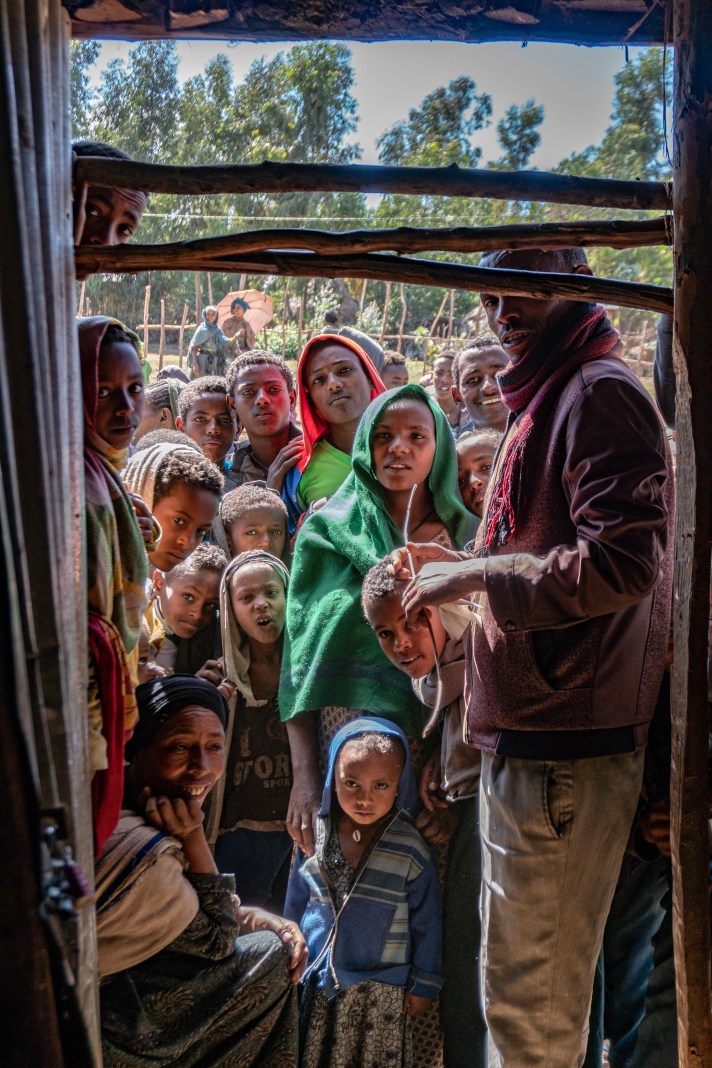
Niall pointed out the contrast that was witnessing children in such numbers so desperate to break into school, but my mind was elsewhere as I imagined the sight of McKenna himself brandishing a makeshift battle-axe at me as I reluctantly sauntered into school late for the ninth time in a single week.
As the groups of children were brought in and addressed by Elaine and Zin, I wandered around the classroom taking in as much as I could. The soil beneath me was uneven and there was dust everywhere. Sets of old, weathered benches and tables were spread across the room with no real symmetry. If you caught the light at the right angle, you could see writing and drawings engraved into these tabletops, which resembled any drawings a child from home would create. On the walls were some posters which looked fitting for a classroom in Europe. They had cartoon pictures of objects and animals with their Amharic and English titles beneath them. It wasn’t clear who made them, but some of the English translations emitted a great deal of joy to us native speakers. At one point, while examining one of the posters, I noticed a break in the stream of light that flowed through the wall just above it. I looked up to see a set of eyes staring at me. It was a younger child who was standing on the shoulders of a teenager so that he could get a good view of what was going on. I waved at him and his laughter caused him to lose balance and tumble to the ground in hysterics.
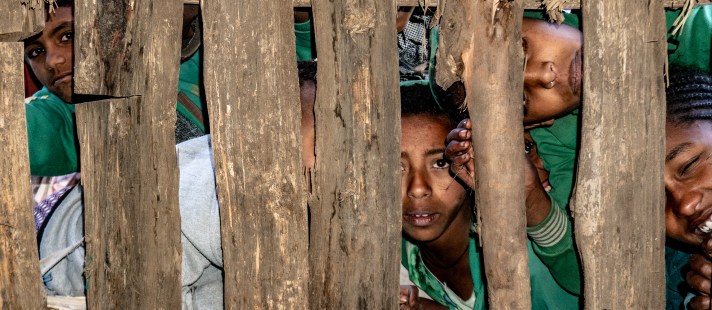
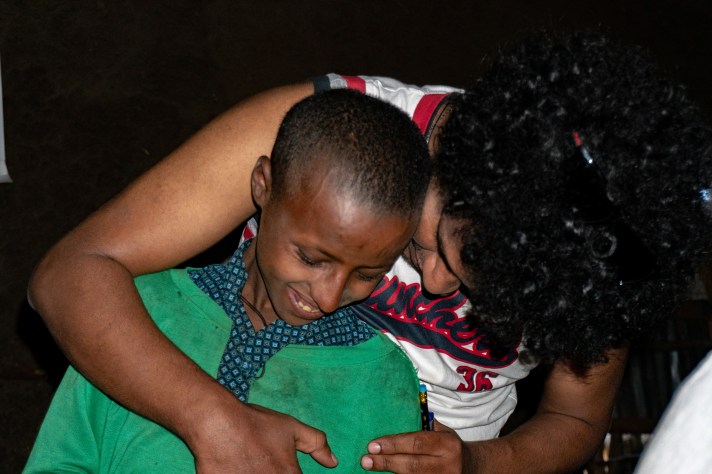
After giving out some of the gifts to the younger classes, the girls who were soon to be entering their early teens were brought in by the teacher. It was a delicate moment which Elaine and Zin knew they had to get right. The importance of the topic was one to be mindful of when talking about, and the intention was not only to teach this group of girls about it, but create an environment in which it could be a topic of conversation without consequence. Elaine, through the translation of Zinabu, explained to the roomful of girls the basics of menstruation and what these changes in their bodies meant to them. This was followed by the distribution of small care packages with sanitary products and of course, once the boys got their turn, the jerseys were shared around.
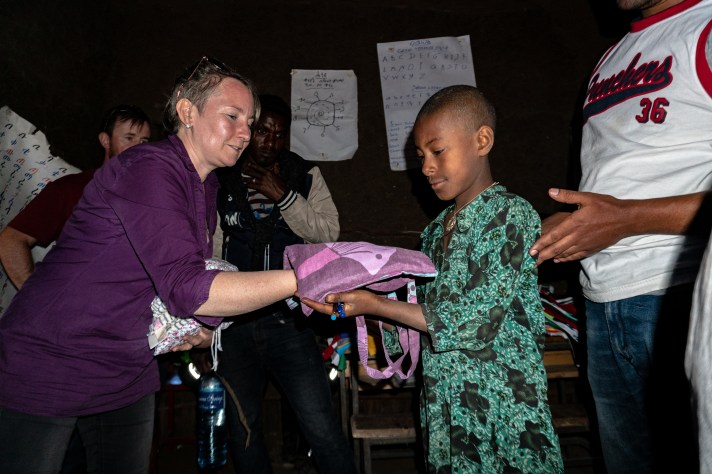
It was a very tiring experience for us all. Niall and Elaine had to quickly sort through bags with virtually no light in order to find the right sized clothes and the right products for the different age groups. They then had to distribute them to the right children, through the operational skills of Zinabu and the other teachers. We must have spent about three hours in the school in total and by the time we left the building a mass of about 200 children and some curious adults had amounted outside. Knowing that we didn’t want to get caught up in the same ordeal as the day before, we did not hesitate to load up the tuk-tuks and be on our way, despite the high demand for handshakes from the crowd.
It was another long drive home through the unforgiving terrain, and we were even more exhausted than the day before. We went to a different hotel for a late lunch/dinner, which turned out to be the hotel associated with the Simien Mountain tours. We all wanted to include a trip to the mountains at some stage, and since we didn’t have anything pressing the following day Zinabu organised a tour for us with one of the representatives there.
We figured it would be a nice way to take a break from the intensity Debark and Quha-Zab-Zaba had bestowed upon us. Niall, Elaine and I spoke about how the boys needed the break the most, trying our best not to admit that in reality we were all desperate for some R&R at this stage. With the recent developments surrounding the possibility of building a well, we knew the latter half of the week would be just as hectic.
There was a lot of downtime that evening. We all hung out in the lounge of the Sona for quite some time but still managed to get to bed early enough. Zin and I drank a few beers and discussed the politics of Israel and Palestine. We concluded that although there were simple solutions, there was no way on earth they would ever be implemented. Between that and the infamous Champions League highlights on their 165th rerun of the week, we called it a night shortly before 9pm. My new room was much smaller than the last but was on the first floor, which was much easier to get to. There were no windows however, and the smell from the bathroom was worse than ever. But frankly, I did not care anymore.
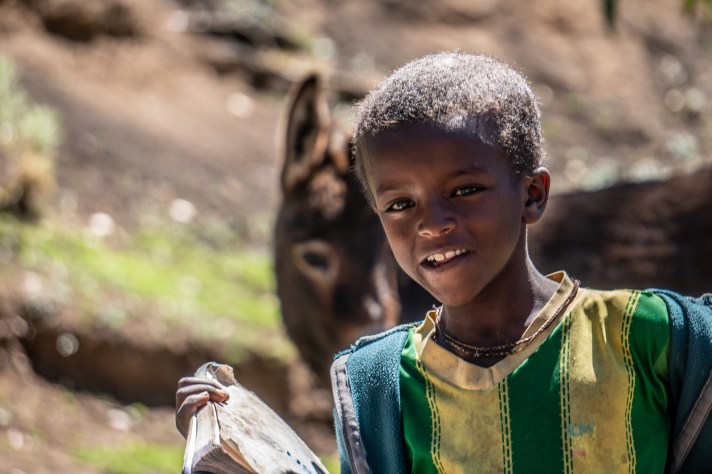
No matter where you go in the world, children behave very much in the same way. They are creatures of immense curiosity and wild imagination. They are happy and enthusiastic, regardless of their circumstances. We see this in the wilderness of rural Ethiopia. We see it in the prosperous suburbs of Rathgar. It is only when they grow older, that circumstance begins to impact their lives in a meaningful way. That is not to say of course that a child’s life expectancy here is equal to that of those in Ireland. Ethiopia has one of the worst rates of infant mortality in the world, with almost 80 per every 1,000 born. This is a chilling figure to comprehend, especially when compared to the 4 per 1,000 in Ireland. But when a child is a child, they do not know this. They are born free and you can see this in their eyes. Although a depressing thought, it is rational to assume that the majority of the children we had met so far would never experience a world outside of the one in which they were born into. And although hopeful, it is indeed difficult to be optimistic about their futures. But this does not deter their joy. And if children can endure conditions such as these to the point of raw delight, I do not believe that the human mind has the power to deny its own childhood instinct of joy.
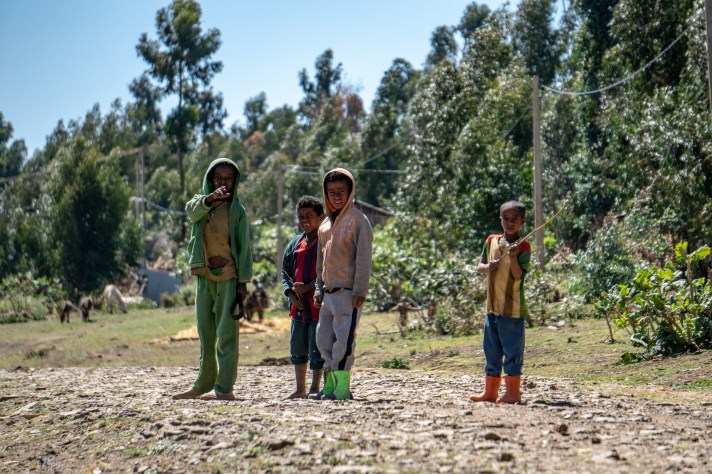
The children of Quha-Zab-Zaba were not a far cry from children I have met in other parts of the world, including those in Ireland. They were often overwhelmed with intrigue, but that is a trait we are all familiar with. They hung around the outside of the school in their own small groups and whispered to each other whilst pointing at these mysterious white folk who had stumbled upon their place of learning. The younger children chased after one another in games of tag and rotten, flat footballs were kicked around by aspiring athletes. There were similarities here that would swipe a westerner clean off their feet, but the most striking of all was the differences. It would be too lazy for me to walk away from this experience – as a whole – and tell people about some sort of cliche ‘perspective’ nonsense that I knew would grab short term attention. You learn a lot about the local people and their way of life, but in truth, I learned a lot more about the people from my own world and their ways of life. We, as civilised westerners, are truly a miserable lot. We cry and groan about things that exist only in our collective imagination, and desperately live in a state of permanent anxiety about death, yet we complacently spend our lives doing things we do not want to do in places we do not want to be.
The children of Quh-Zab-Zaba will teach you a lot about their lives, but more so, they will teach you about the life in which you lead yourself.
Full gallery of images from the aforementioned day below.


