*If this is your first time reading the ‘Where the Happy Folk Live’ series, it is recommended you read Part 1 first.
No one knows me in the morning… No one sees me go walking by… And if I listen while no one answers, the winds can only echo a goodbye…- Frank
Too long has passed since the last installment. Sitting down to translate my notes from this wild adventure into legible and somewhat respectable text after such a lengthy absence comes with some unexpected challenges. My notepad, which stayed close to me throughout my stay in Ethiopia, has begun to enter stage 3 of rigor mortis. It was sweated into, stood on and once accidentally flung overboard a tuk-tuk during a drag race. If anything, this notepad was the true champion of the journey. But the brutality it faced has taken its toll. It has lost the will to continue, so extracting every ounce of information I can is crucial. Another challenge is trying to recall what happened on each day. Unfortunately I – in all my wisdom – failed to enter my notes chronologically, nor did I label the scattered paragraphs with the respective days. This has caused ructions in my attempts to recall what happened and when, but I believe I am back on track. I will post photos of the original notes avec the final chapter.
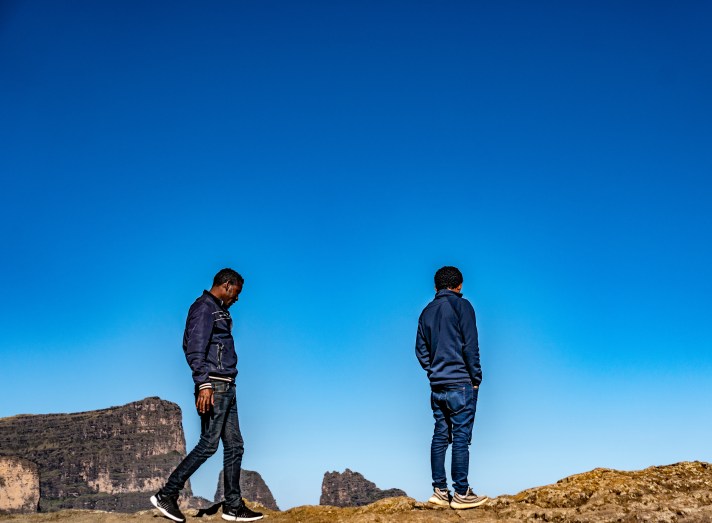
Following the savage beating our fragile western morale had taken on Sunday and Monday, we took it upon ourselves to avoid any heavy encounters on Tuesday. A day in the Simien Mountains was an attractive alternative to humanitarian work.
There was a certain element of bliss when I awoke that morning. That millisecond period you experience while brain kicks when you wake up had been followed by a cocktail of sweat, uncertainty and fear every morning this far. But not today. Perhaps knowing that there was no real responsibility looming over that frosty Tuesday morning made things different. Or perhaps it was the booming sound of Muslim prayer that echoed from the nearby Mosque at 5am that distracted me from any doubts that patiently waited to kick in.
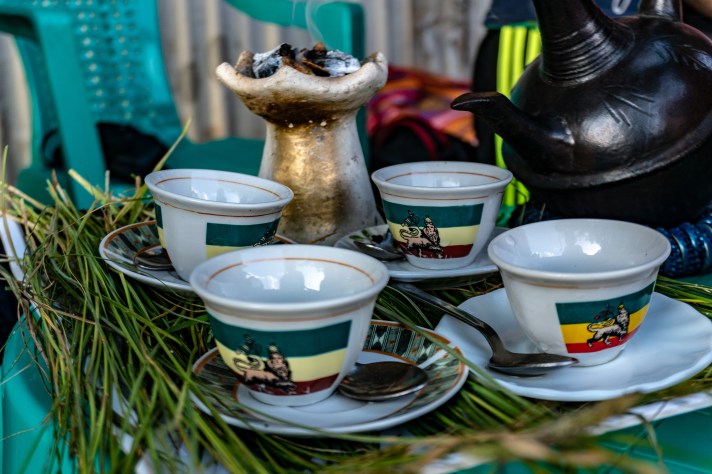
We met downstairs at about 8am. Our usual breakfast was followed the most pleasant visit to a ‘cafe’ – and I cannot emphasise enough how loosely I use that word in this context – that Zinabu had discovered next door to the hotel. The cafe was a small garden area that sat on the edge of the road leading around the side of the hotel. It had several small plastic chairs and tables of different colours and lead into a typical Debark home. It was run by an older woman, maybe in her 50s, as well as several younger women and children. They served coffee that was not only roasted on an open fire a few feet away, but served with lit frankincense which gushed around you as you sipped on your coffee. It was made in a very similar manner to that of Mesefnt’s wife’s effort a couple of days before and it was indeed difficult to judge whose coffee was best, although both were remarkable. The seven of us sat there for about an hour that morning and watched the town come to life. Schoolchildren of all ages skipping and screaming as they chased one another through the streets, young tuk-tuk drives scanning the alleys looking for their next job, elderly women gliding across the roads and in and out of corrugated iron doors speaking only in whispers and large trucks held together with eucalyptus and rope desperately attempting to manoeuvre through the madness.
We returned to the hotel for some reason or other and were hanging out in a sort of alfresco area where we had met with Mesefnt and Guadada initially when we were joined by a group of terribly well-spoken British folk. One man, who looked like a vintage model of Jeremy Vine and spoke like Attenborough sat beside us and began rolling a cigarette. He was dressed exactly how you would have expected him to be dressed – a loose blue shirt covered by a droopy beige gilet and matching khaki pants. He was a friendly gentleman with plenty of stories to tell and once he learned of our agenda for that day he gasped with a kind of nostalgic excitement. Sebastian was his name, which, frankly was the most fitting name this man could possibly have had.
Our Hilux arrived at about 9 and the driver was accompanied by our guide for that day and a very old looking man carrying an even older bolt action rifle. He didn’t say much, but he was always smiling. I wasn’t sure why he was there at first, but it was later explained to me that, in order to attend the Simien Park tours, it was required to be accompanied by a ‘scout’, who were generally older, thinner men who carried rifles. Our guide, on the other hand, spoke decent English and was happy to answer any questions we may have had. He informed me that the reason for the scout was mainly just to deter any unwanted attention from wilderness villains.
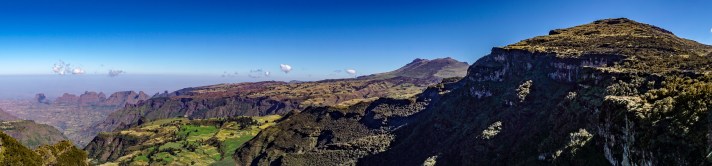
The Simien Mountains National Park was set up as an official venue in the late 1960s by a British/Japanese man they call Clive. The park is approximately 400 square kilometres in size – over 3 times the size of Dublin City – and has peaks reaching as high as 4,500 metres. During the civil war in the 1980s, the park’s wildlife saw a troubling decline in numbers, which provoked the United Nations adding the park to its list of World Heritage Sites in Danger in 1996, where it continues to be monitored.
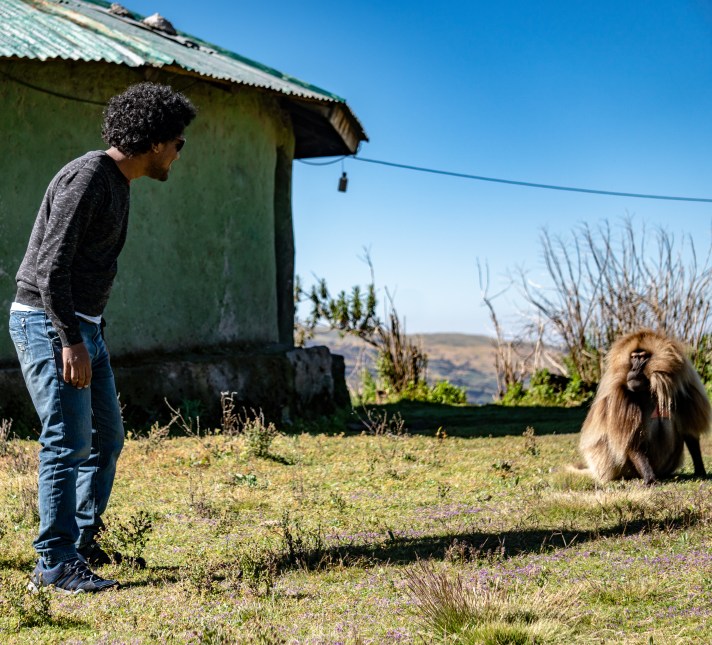
The park has built her international reputation for many reasons. Despite popular belief that this area of East Africa is nicknamed ‘The Horn of Africa’ because of how it is geographically outlined on a map, the name actually represents the towering and pointed Simien Mountain region of northern Ethiopia, which at the right angle surely resemble horns. At least, this is what I was told by those from the area. But it makes sense, given one of the most iconic animals that inhabit the high-altitude wilderness. The Walia Ibex – a species of goat which is native to the area – are immediately identifiable by their large, intimidating horns that could kill a man with one jab and their awful thousand-yard stare that cuts through your soul like a rapier. The Ibex who guard the higher reaches of the park share this breathtaking utopian wilderness with several other passive communities. These include the bleeding-heart baboon, a reluctantly friendly bunch who seem stoic for the most part, but one wrong move and your family safari could soon leave you feeling like a Labour TD on any given day in Jobstown. Then there are the ‘cliff-springers.’ These curious and frightful fellows resemble abnormally small deer who, rather than enjoy a relaxing life on the prairie, trek the most ferociously steep cliffs and rocky falls, constantly analysing their surroundings. They have slender, gaunt faces and upon noticing you – which they surely will many minutes before you notice them – will stand motionless with a similar stare of their Ibex neighbours. Their facial gesture reminds me of the common occurrence of a young UCD freshman gazing pensively into his own reflection in the crowded bathrooms of a busy Dublin nightclub. He is seriously out of his depth on pills he bought from a Chilean Deliveroo rider in the D2 beer garden, and although fully aware of his regrettable decisions, knows he has less control over his future than anyone else in that cramped, stale restroom.


Of all the endangered plants and animals that co-exist within the confines of the park, the most interesting is no doubt the human delegation. As the driver of our large white Hilux continued gingerly along the broken path, there was a clear view from the right side of the vehicle down into a silent, gaping valley. The ground was mainly grassland and divided by clusters of rock, dirt, shrubbery and the occasional homestead. The scattered homes on view that dictated the land below us were much like the ones we had visited earlier in the week. At least that’s what we could best make out from about half a kilometre in the clouds. However, unlike those of Mesafnt and his neighbours, there were no clear signs of paths or trails connecting these homes to the world, let alone roads. The homes seemed to just exist in their own right, as if in a world separate from our own but reflected into this abyssal valley.
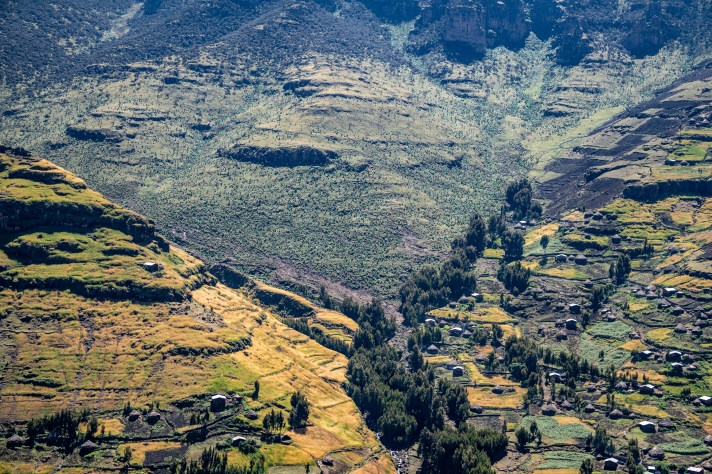
I asked our designated guide about the people who lived in these homes. I presumed they were potentially staff, a park ranger sort of thing, but he informed me that roughly 2,000 civilian farmers were living in the park. Apparently people had been living in the park for far longer than the official boundaries of the park were founded – which makes sense. However, in order to promote sustainability for the park’s wildlife, hundreds of these people have been gradually relocated to different parts of the Amhara region – a topic of great controversy among some.
We spent most of the afternoon exploring the trails of this rocky paradise. The sun was scorching and the air was still. Staying in the car seemed wasteful, so we spent as much time on foot as was physically possible. This was far from any national park I had been to before. There were no official-looking men in high-vis jackets monitoring the goings on. Similarly was the lack of hoards of western folk gathering around statues and conniving clampers on the prowl for their next catch. Health and safety – as with almost everything I had encountered so far in Ethiopia – was too given little concern. At one point we were led across a small scattered stream tucked away beneath an archway of curving trees. We made our way down a series of natural steps for about 10 minutes, before entering a narrow clearing. Between densely packed trees and the faint echo which sounded like white noise, you could just about make out a rather sharp fall on the far side of the tree line just a few feet away. The guide, Zinabu and Nacho proceeded to mutter a few words of Amharic between one another before taking turns climbing onto a large rock. The guide stepped extremely carefully along the rock before hopping down onto another surface on the far side of the tree line, just out of sight. Nacho and Zinabu encouraged us to follow with the utmost caution, which we eventually did, despite Niall’s many objections.
On the far side of the tree-line was an even smaller area – no larger than an average back garden in Beaumont – with a view to top them all. We stood over a narrow but endlessly deep valley that seemed to cut briefly into the side of the closest peak like a chapped lip. The source of the white noise was now very clearly in sight, too. A gaping hole in the far wall of the valley bled out a spectacular waterfall which spewed down farther than we could see.
Between stalking goats, staring down baboons and playing with old Russian rifles, the day in the mountains was not only beneficial to our morale, but a standalone adventure in itself. Seeing animals such as those live lives in places such as this is a sight I fear is a declining occurrence in my life. Despite the troubles Ethiopia has faced throughout its existence, a portion of its people still dedicated their lives not for benefit of themselves, not for validation, but for the preservation of another species of animal. Strange.
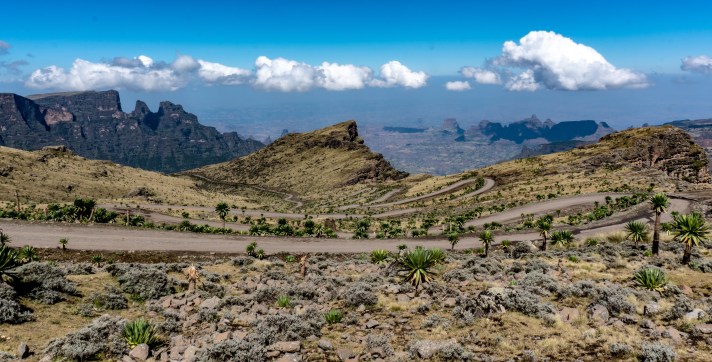
The hour’s drive back felt far longer than the hour there, but that was likely due to the fatigue. We were so high up that the sun felt far hotter than ever and shade was our closest ally. We had done quite a bit of walking and trekking around the mountains and at one point I crawled a few metres across some damp ground in order to get a sneaky shot on an unsuspecting Walia. Despite convincing ourselves that we had comfortably acclimatised to the altitude after almost a week, our bluff was called by the now 4,300+ metre altitude. The air was too thin now and made for many moments of haziness and disorientation.
At least it must have been, because I have no notes on the remainder of that day nor any memory. In all likelihood, I was asleep by 8pm.
This indeed makes sense, as it was the following morning that I woke up at 5am after eight or nine hours sleep. It was unlike any other morning. There was a loud silence for miles around as Debark was not awake yet. Nor was breakfast for that matter and with the sun still considering its opening move the hotel was bitterly cold, so I lingered around the lobby and tried to make some small talk with Gurma who was lounging about in his pyjamas. He seemed totally fixated in whatever exchange he was having on his phone. I got the impression it was he who managed any bookings and the like, which given how much other work he had on his plate was impressive. Sona is not the type of hotel which you can simply book through bookings.com. Oh no. You are required to call ahead of your visit and hope – pray – you get through to Gurma should you not have a knowledge of Amharic.
Although friendly, he didn’t seem to be much in the mood for small talk that morning and since breakfast wasn’t being served for another half hour I went to see if that family in the adjacent house were serving coffee today. Unfortunately, there were no signs of life there either, but given how cold it was I didn’t much fancy sitting outside. I sat with Gurma until breakfast was ready and managed to get in early while the full range of food was still available. There were a couple of other travellers in the food hall at 6am, but it was too early for any interaction. I ate some egg and potato and scribbled some notes when I heard the faint call of a cat. It was about 6:20am now and the town had just entered rush hour, so there were plenty of sounds bouncing around. But having grown up with cats in the house my entire life, recognising that sound came instinctively. I turned and saw a small, lean cat making her way around the jungle of table legs and draped covers, rubbing her head forcefully against every other table leg and purring. It is highly advised by most professionals and veterans that you should give wild animals – or any animals for that matter – a wide berth in these parts, so I refrained from interacting with it to that extent. With nobody watching, I tossed a bit of scrambled egg in its general direction and it rushed to scavenge every last molecule before a member of staff shooed it away.
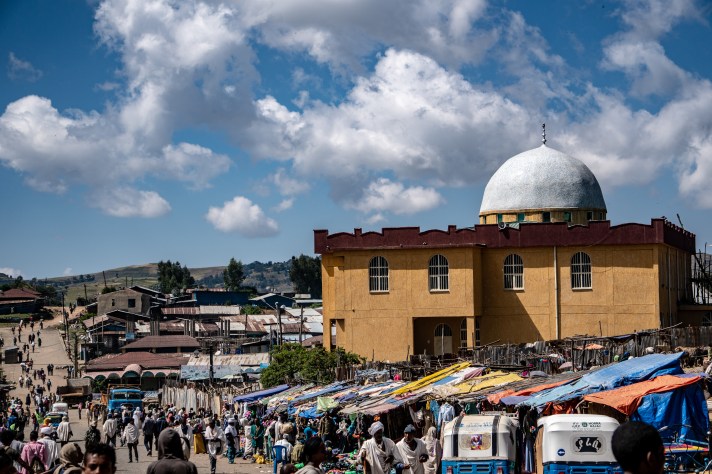
Today would be our second attempt to purchase animals for Mesefnt, Guadada and their respective families. I should have noted in part 3 that they, with the assistance of Niall, Zin and Nacho, did not find the oxen they sought on. Apparently the Saturday market can be a bit hit and miss, but the Wednesday market was a reliable source of a good Ox.
There was still no sign of the others by 6:30 so I tried my luck again with the coffee house. They were out in the garden setting up their assortment of plastic chairs and tables and recognised me immediately as I turned the corner. The older of the women gestured me over and started making the coffee. She didn’t speak any English and my Amharic was just insultingly bad, so we communicated with facial expression and gestures. It seemed to be just her and two or three young children, although by 7am a woman about my age emerged from the household and started helping out. At that stage Zin had joined me, who found me out there by chance. The two of us chatted about some passive topics with no real enthusiasm, as I believe we were both just completely captivated by our surroundings. There was something about Debark that morning. Something I could not put my finger on at the time. The more I think about it – the more I look back – I think I was beginning to feel less like an extra-extraterrestrial. Of course, there was no amount of time allotted to this reality in which I could ever become totally integrated, but I believed I was getting close to the closest I could be.
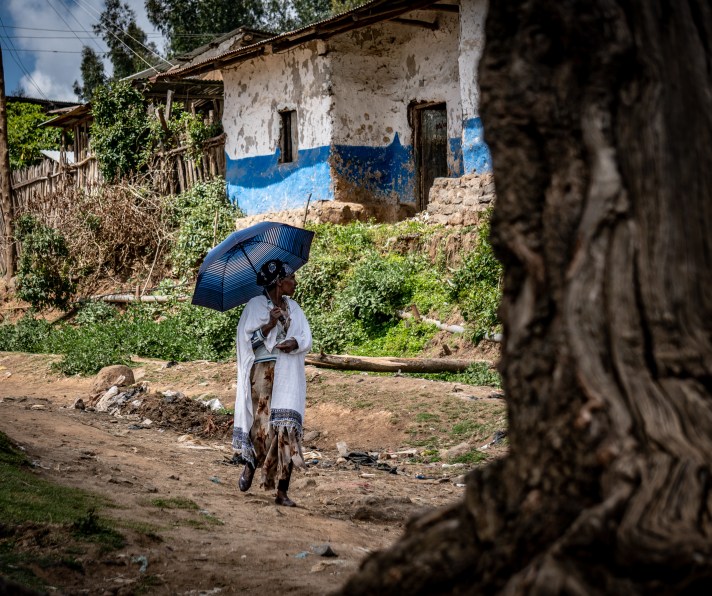
My trail of thought was interrupted when the younger of the women approached me and presented a handful of bottle caps. Zin laughed and I was shocked. For context, I have a hobby of collecting bottle caps. Whether in Ireland, France or even Ethiopia, I try to acquire as many as possible. However, this being a coffee shop, there was no obvious reason why they would have them. It seemed clear – much to Zin’s amusement – that word had spread around town of a badly dressed white man who was collecting bottle caps in restaurants and hotel bars. It was a gesture I did not expect and once the shock had departed I was very grateful.
Zin and I were joined by Mesefnt, Guadada and her husband, who spotted us on their way to the hotel. They sat with us for about twenty minutes whilst we waited for the others and they chatted away in their native tongue. I didn’t much mind that I couldn’t participate in the conversation because having the opportunity to observe this encounter was, from a journalistic point of view, immensely satisfying. Here were a group of people, one of whom now lives thousands of miles away in developed Israel and the others who live deep in the confines of the third world, sitting in pink plastic chairs and laughing about God knows what. If the scene was described to someone on the outside, it would be easy to imagine the whole interaction as something completely alien to us and beyond our imagination. But this could not be further from the truth. This scene that took place before me was like many I had witnessed before. There were a group of people who all knew each other chatting away and sipping on their coffees in the early hours of a bustling town’s morning. There was nothing strange or foreign about this at all. I had watched this play out in South William Street, Eyre Square, La Rosiere and Prenzlauer Berg many times. The only difference I could tell – despite the language barrier – was the authenticity of those present.
Once the others were ready and Nacho had arrived, we finished up our coffee, paid the older woman a generous fee and made our way back to the market. To my surprise, both of the boys joined us, despite being given the option not to. Their courage and endurance was without question one of the most eye-opening elements of this adventure so far. I can’t say for sure how a nine-year-old Evan would have coped with this week, but I doubt he would have displayed the same level of tolerance as these two boys.
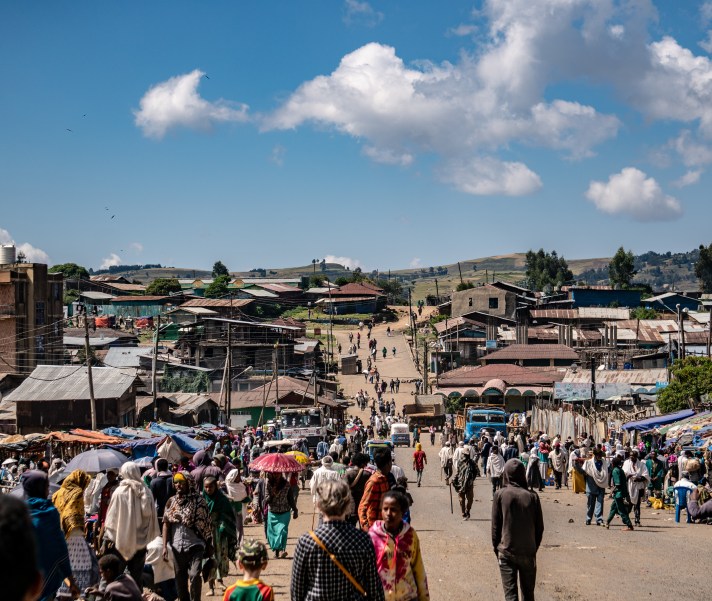
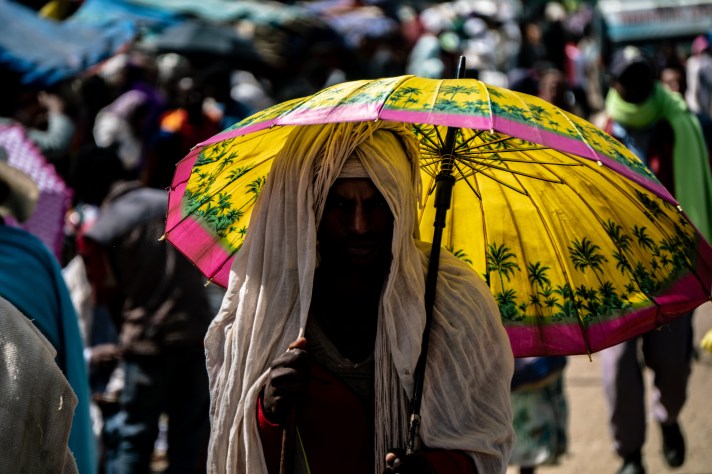
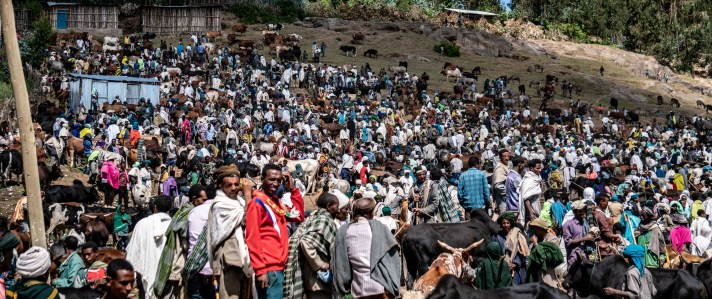
We took the long way to the market. That meant avoiding the main roads and working our way through the alleyways around Debark, which like Saturday were flooded with street vendors and merchants selling everything from old phones to flip-flops. The place was thick with crowds who, although many stopped for a good inspection of us, cared little about our presence for the most part. There were some items that caught my eye, but before approaching anyone Zin advised to wait until we were back in Gonder as the overall selection and quality of goods would be much better. We eventually came to the trench that was the entrance to the animal market. It was considerably busier than the last day, with crowds so dense it was hard to move through the market. There was cow shit everywhere, to the point that I no longer tried to avoid it, no real wisdom in doing so anymore. The swarming occurred around us when we arrived, as expected, but it was not nearly as intense as before. Perhaps the novelty really was wearing off us or perhaps we were getting better at blocking it out. It was particularly sunny that day so I took off my jumper and fashioned a sort of head-scarf around the top of my cap, protecting the back of my neck. I was not the only one sheltering from the conditions as many of the locals – both men and women alike – carried decorative umbrellas over their heads to suppress the glare.
News emerged that there were a couple of very fitting oxen available and within the budget. Now obviously we all couldn’t just saunter up with our nice clothes and white skin expecting to get the same price. That’s not how things work here. The plan of action was that the Ethiopians of the group would secure the deal with the owner of the oxen and then meet us around the corner. The market itself was far too wild to go exchanging this amount of money, so it made sense to do it somewhere a bit calmer. As we turned to leave, I heard a booming commotion coming from behind me, followed by a young man frantically pulling my shirt. I glared at him with piercing dissent and threat. What was this man doing? I was moments from bursting out in a foul reaction when I realised he was, in fact, pulling me out of the path of a loose ox that had lost its temper long before I. It was kicking its back legs and swinging its horns frantically, with no regard for the many thousands of people who surrounded it. After some scattered panic from all involved, a couple of men managed to lasso a rope around its neck and somehow calm it down. I thanked the young man who alerted me and we continued to make our exit.
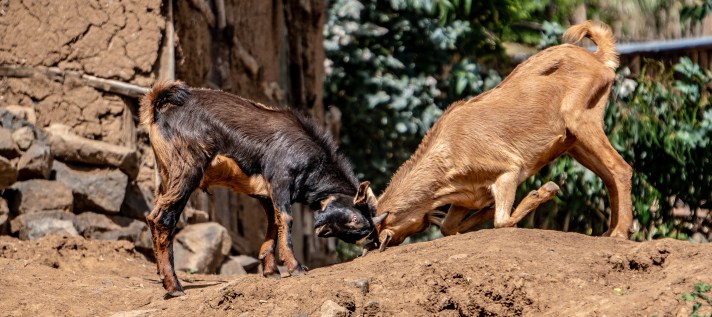
The procession, which included the ox merchant, Mesefnt, Guadada, Guadada’s husband, Zin, Nacho, Niall and I made our way about 500 yards down the main road and onto a small grass patch between some houses. I think Elaine had returned to the hotel with the two boys at that stage. Niall, who was carrying the very large sum of cash in a backpack worn on his front, walked with Zin as we came to a stop by a group of goats that were lying in the shade of an awkward tree. As the several Ethiopians mentioned above – as well as a procession of cousins, uncles, aunts, neighbours, brothers and curious onlookers – began talking back and forth in Amharic, I took the opportunity to watch a pair of goats across the road get into a heated debate over something likely very serious. The debate collapsed into violence when one of the goats called the other’s mother something unpleasant and the pair locked horns in a vicious brawl. It lasted for the duration of the ox negotiation, but I doubt either side walked away with any significant sense of victory nor pride.
Zin was no doubt the leader of the negotiations given his involvement and general charismatic presence. Eventually hands were shaken, papers were signed and Niall’s large stacks of cash were exchanged for the pair of oxen. By all accounts, both animals were of great quality, but I had to take their word for it given my lack of knowledge in the field of Ethiopian farm animals.
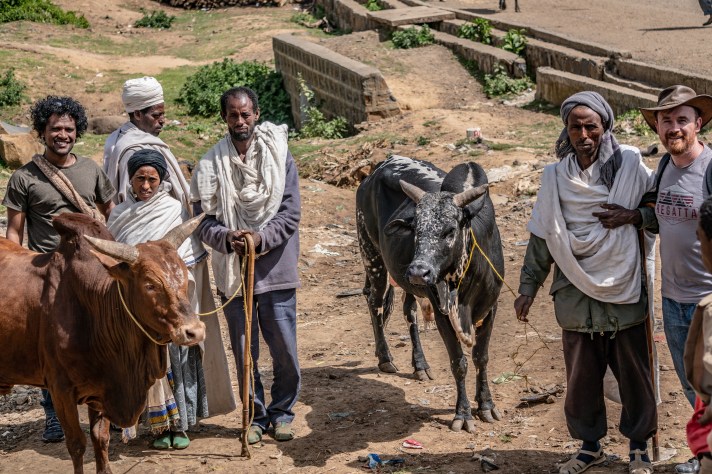
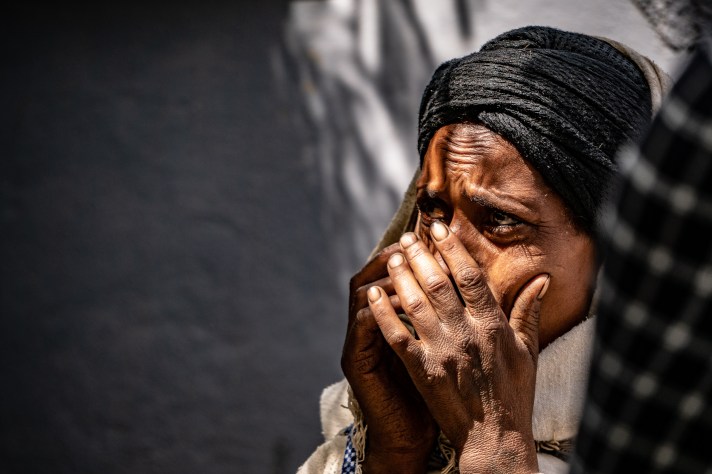
With the deal done and only the relevant people remaining, we took some photos and headed back to the hotel. This was the last time we were going to see Guadada before we made our way back to Gonder, so it was important to have some quiet and intimate time with her. Guadada’s husband headed back to their home with their new ox and a Mesefnt did the same shortly afterwards. Nacho also headed out for a while, leaving just the Irish folk, Guadada and Zin. We were all sat in the garden area of the hotel where we had Sebastian the previous morning. Niall, Elaine and Zin sat at a longer table with Guadada, while I kept the two boys entertained between snapping pictures of the conversation. It was going to be a heavy conversation no doubt, so I made sure to be as subtle as I could. Indeed it was a heavy conversation. Although I didn’t catch it all – nor do I wish to share the details of what I did hear – it was not the content itself that shook me, but the significance of it. Of all present, Gaudada was the most emotional. Her somber reaction alone was difficult enough to swallow. The more I thought about the significance of this meeting, the less the reactions came as a surprise. With the life expectancy being as harrowingly low as it is in this corner of the earth, the possibility of the boy’s birth mother never meeting him again was all too real. From the outside looking in, this was a thought that cut through me. I cannot begin to imagine being in the shoes of anyone at that table.
Once the final goodbyes with Guadada were made, the family took a moment to relax and gather themselves in the hotel. It was about lunchtime at this point and while I sat in the garden area of the hotel enjoying a Habesha beer, Nacho returned from his travels. The rest of our party made their way back out to us and Nacho told us of a nice place to go and eat nearby.
It was not somewhere a tourist had ever been too, that was certain. The makeshift restaurant was on the roof of someone’s house and as we soon learned, meat was not served on Wednesdays and their cooking facilities were out of action. This was problematic for many reasons and eventually we decided to wait until the evening to eat. Instead, Nacho took us for some coffee in a street-side “cafe” not far from the market, where we received plenty of odd looks from the regulars.
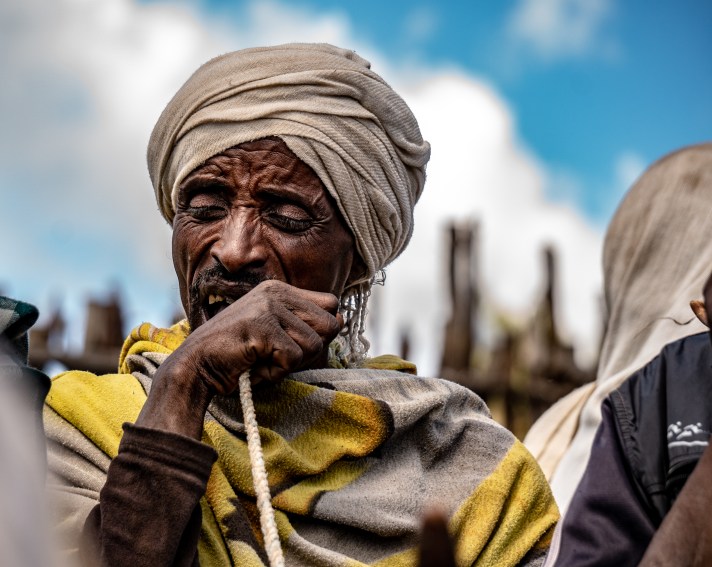
We sat outside on the side of the main road sipping our coffee when a familiar face appeared from the ocean of people. His booming voice called out for Nacho as his hands waved about frantically. It was Denis! The smiley social worker on the dirt bike! They had a great Amharic laugh for a few seconds and shortly afterward I was informed that we were going to be accompanying Denis to the local government offices in Debark that evening to speak about the possibility of installing a well in Quha Zab Zaba, an idea likely stemmed from Elaine and Niall’s expressed interest in the possibility when we had visited the school on Monday.
We finished up our coffees and hailed a couple of tuk-tuks. The offices weren’t far, but given how cheap it was to take the tuks there was no sense in walking. The evening sun was starting to make itself known now. It hung low and almost exactly in line with the main street. It sort of wedged itself between whatever buildings it could find and snuck through like a glass of spilled milk making its way through each and every piece of cutlery it can.
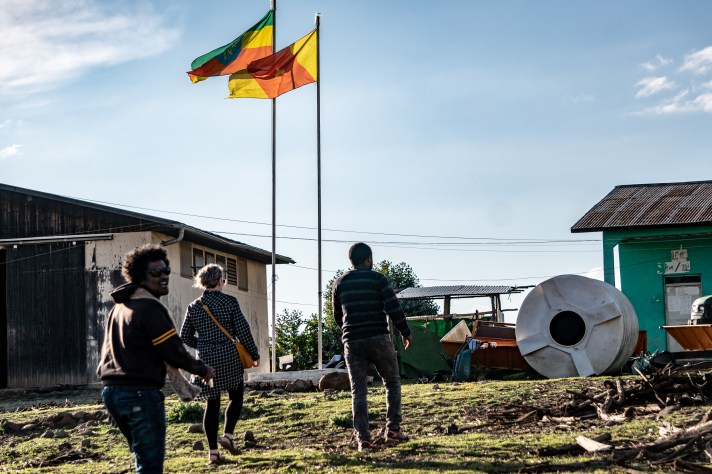
The offices were all single-story buildings that were surrounded by what appeared to be army barracks. They made an outline for a large, empty space of land scattered with rocks and animal bones. I took a couple of photos outside, but realised I had better keep the lens cap on once we went indoors, given the relationship between the Ethiopian government and journalists I referenced before. We were eyed up by some soldiers carrying assault rifles and submachine guns who were loitering about without much to do before eventually being invited into a small office. The room was in keeping with the rest of Debark’s interior design: it was run down and looked like no one had been inside it since it was built in the early 1990s. The walls were painted olive green but were cracked and dusty. A4 pages were stuck to the walls without any mention of a spirit level, some displaying posters and others displayed hundreds of numbers and graphs. I don’t know what they were meant to be, but it almost looked like they were just put there for aesthetic’s sake. We sat along a series of chairs against the wall whilst Zin and Denis spoke in Amharic with the two government officials who had little to no English. They spoke purely in Amharic for about 15 minutes while the rest of us sat quietly and desperately tried to understand the body language before us. They were hard men to read, but Zin said he would fill us in once we got back. Apparently, it was a difficult task to pin these officials down for a conversation, so they didn’t see the sense in using up expensive time translating what was being said.
Once the conversation came to an end and we all stood up to leave, one of the government officials used his very broken English to thank us for coming. We hopped back into a couple of tuks and regrouped over dinner. According to Zin, the conversation went very well. The officials were delighted to be offered the help and would be sending out a couple of geological types to survey the land – along with ourselves – the following day. This was great to hear of course, but nobody was getting their heads lost in the clouds. It doesn’t take a historian to uncover Ethiopia’s hereditary issue with corruption and bureaucracy, especially when the government is involved. This meeting had opened a new door into an entirely new project which would require a great deal of oversight, planning, cooperation and transparency. Of course, this all hung on whether or not it would actually be possible to build the well. With little to bother concerning ourselves about that night, we spent the evening playing chase-the-ace and watching Champions League highlights before getting an early night. Tomorrow would be our last day in Debark, and there was much to be done.
Full gallery of images from the aforementioned day below.


